AI Audience Segmentation: Personalize Content at Scale Without a Team
Learn how ai audience segmentation helps content creators deliver hyper-personalized experiences to distinct audience segments in real time without a big team or budget.
Details
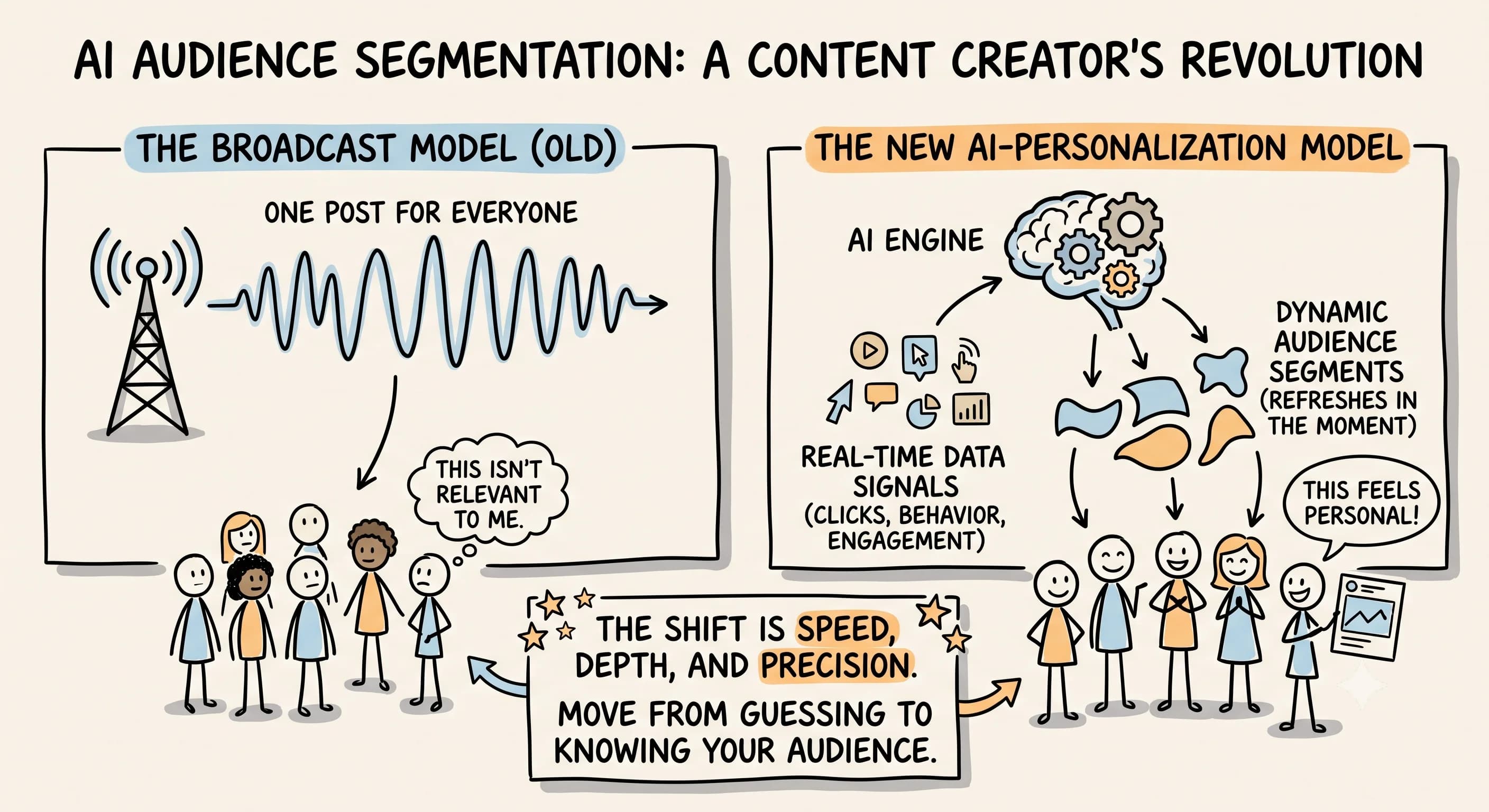
AI Audience Segmentation: How Content Creators Can Use AI to Personalize at Scale
Your audience isn't one person. It never was. But for most of content creation's history, you've been forced to publish as if it were — one post, one email, one video for everyone on your list. That's the broadcast model, and it's quietly costing creators audience loyalty every single day.
AI audience segmentation changes that equation. It gives you the ability to divide your audience into distinct groups, understand what makes each group tick, and deliver content that feels personally relevant to each of them — all without hiring a data team or spending weeks manually slicing through analytics. According to IBM, hyper-personalization is the use of AI, machine learning, and real-time data to tailor experiences to an individual's behavior, preferences, and context. That's not enterprise-speak. That's a practical description of what's now available to individual creators.
Let's break down exactly how AI-driven segmentation works, why it matters for audience building, and how you can start using it today.
What Is AI Audience Segmentation and Why Does It Matter?
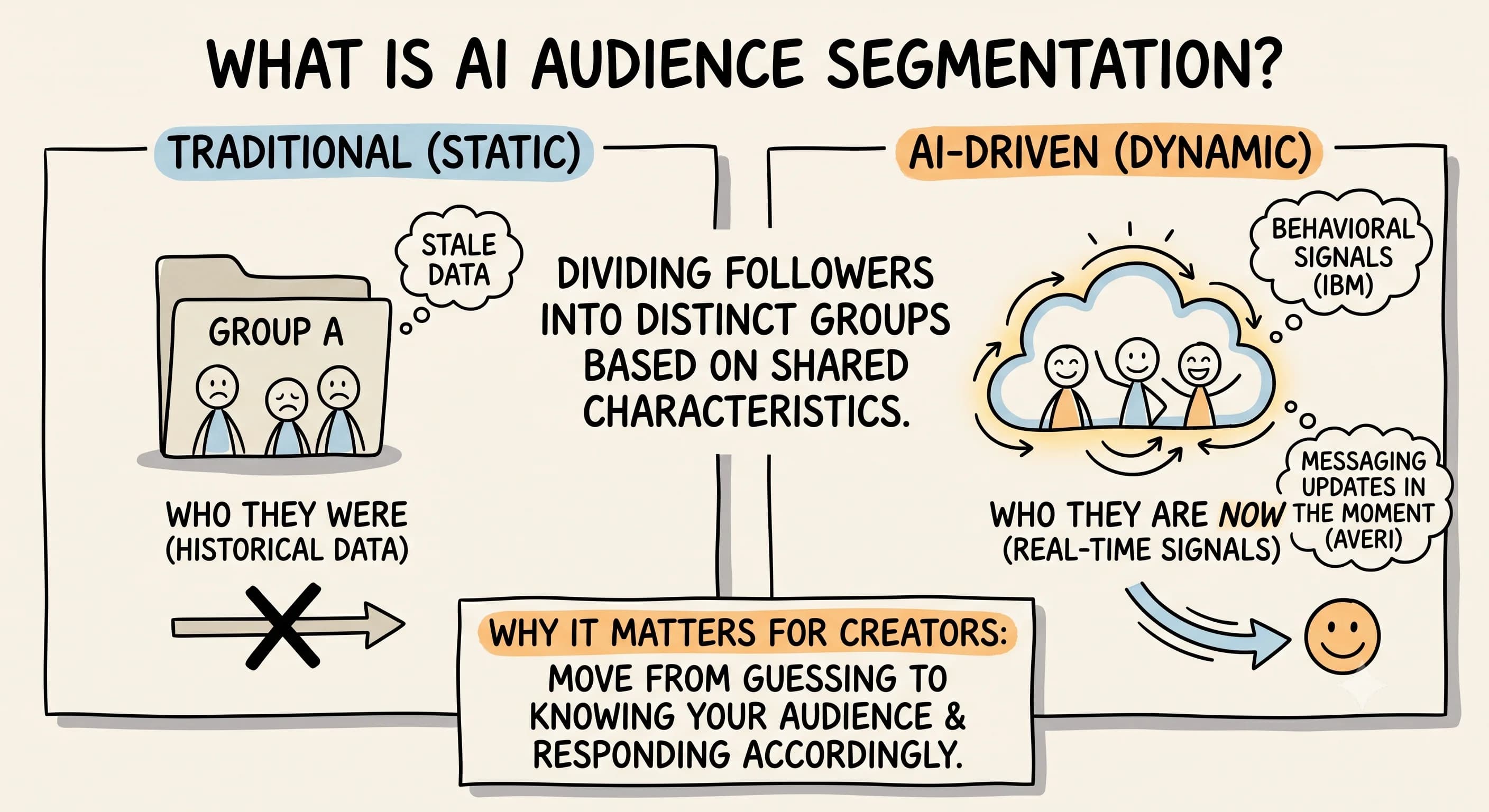 At its core, audience segmentation is the practice of dividing your follower base into distinct groups based on shared characteristics. Traditional segmentation methods worked with static data. You'd manually group people into buckets, update those categories occasionally, and hope the picture still reflected reality.
AI audience segmentation takes this several steps further. According to Averi, real-time audience segmentation means groups aren't static — they update as new signals arrive, so the system can change messaging and delivery in the moment. That's a fundamental shift from the old model, where your content strategy was always chasing who your audience was, not who they are right now.
What separates AI-driven segmentation from traditional segmentation is speed, depth, and precision. AI capabilities now include analyzing hundreds of data signals simultaneously — content engagement patterns, click behavior, time-on-page, platform-specific interactions, purchase signals, and more. According to IBM, segmentation should be based on behavior, preferences, and outcomes, not just demographics. That distinction matters. Demographic data tells you who someone is. Behavioral data tells you what they actually do, and that's where the real insight lives.
For content creators focused on audience building, this means you can finally move from guessing what your audience wants to knowing — and responding accordingly.
The Power of AI: From Broadcast to Personalized Delivery at Scale
The practical goal of AI-driven segmentation is moving from one broadcast message to many segment-specific or individualized experiences delivered at scale. IBM describes this shift as the central purpose of hyper-personalization. It sounds ambitious, but the mechanics are more accessible than most creators realize.
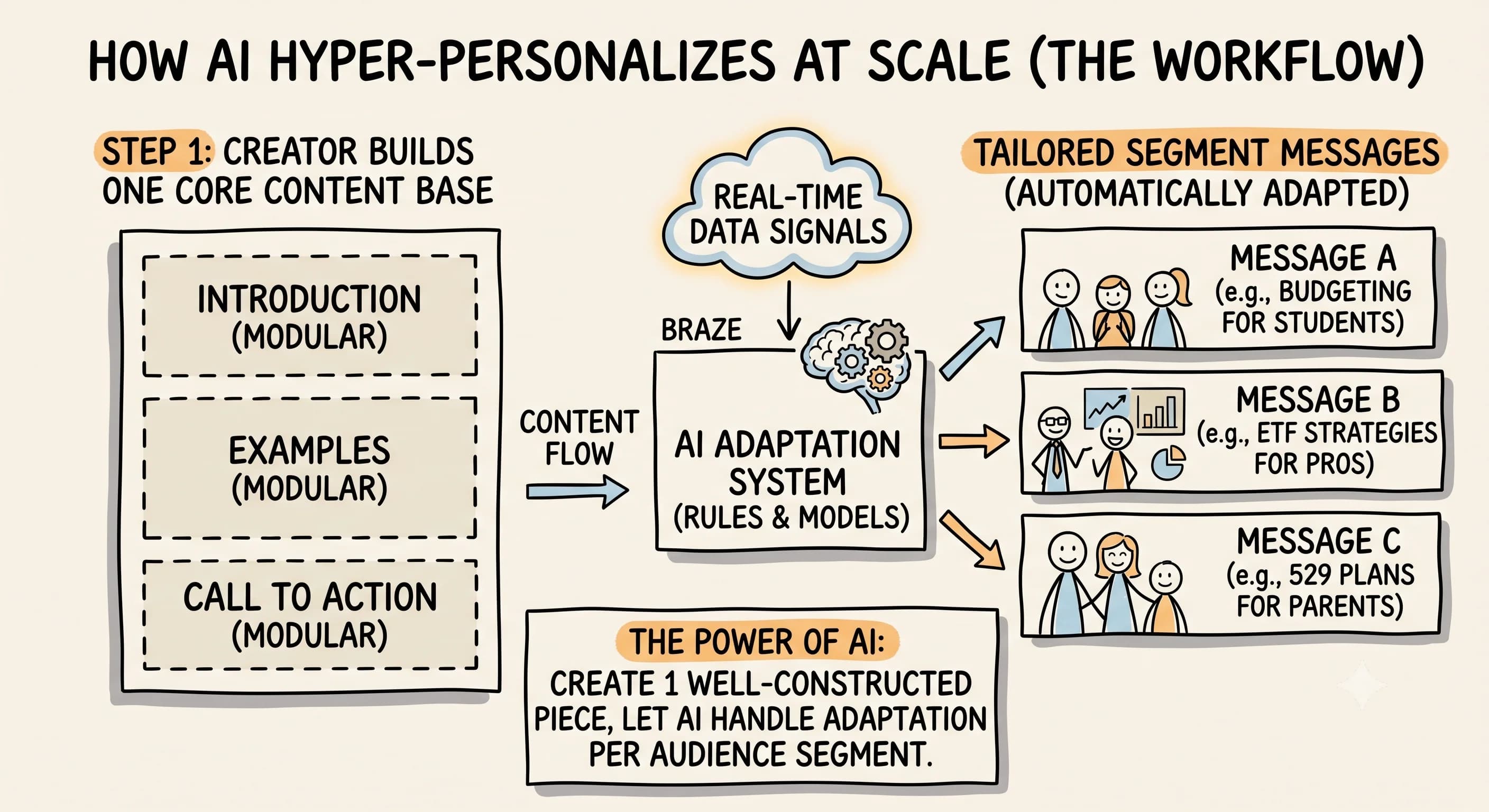
Think about a content creator running a personal finance newsletter. Their audience likely includes college students managing debt, young professionals building their first investment portfolio, and parents planning for their children's education. Each of these customer segments has fundamentally different financial priorities. Under the old broadcast model, the creator writes one newsletter and hopes it resonates with someone. With AI-powered customer segmentation, that same core content gets adapted — budgeting basics for students, ETF strategies for young professionals, 529 plan insights for parents — all delivered automatically based on segment-specific signals.
According to Braze, the best implementation pattern is to create one content base and let rules, models, or generative systems adapt it by segment. That's not a shortcut. It's a smarter way to work. You're not producing three separate newsletters — you're producing one well-constructed piece of content with modular components that AI tools customize per audience segment.
This is the power of AI in practice: it doesn't just help you create content faster. It helps you create content that actually connects with each distinct audience segment, driving deeper engagement, stronger loyalty, and ultimately a more sustainable creator business.
Key Benefits of AI Customer Segmentation for Content Creators
Benefits of AI-Driven Audience Building
The benefits of AI customer segmentation extend well beyond better open rates or higher click-throughs. Here's what content creators stand to gain:
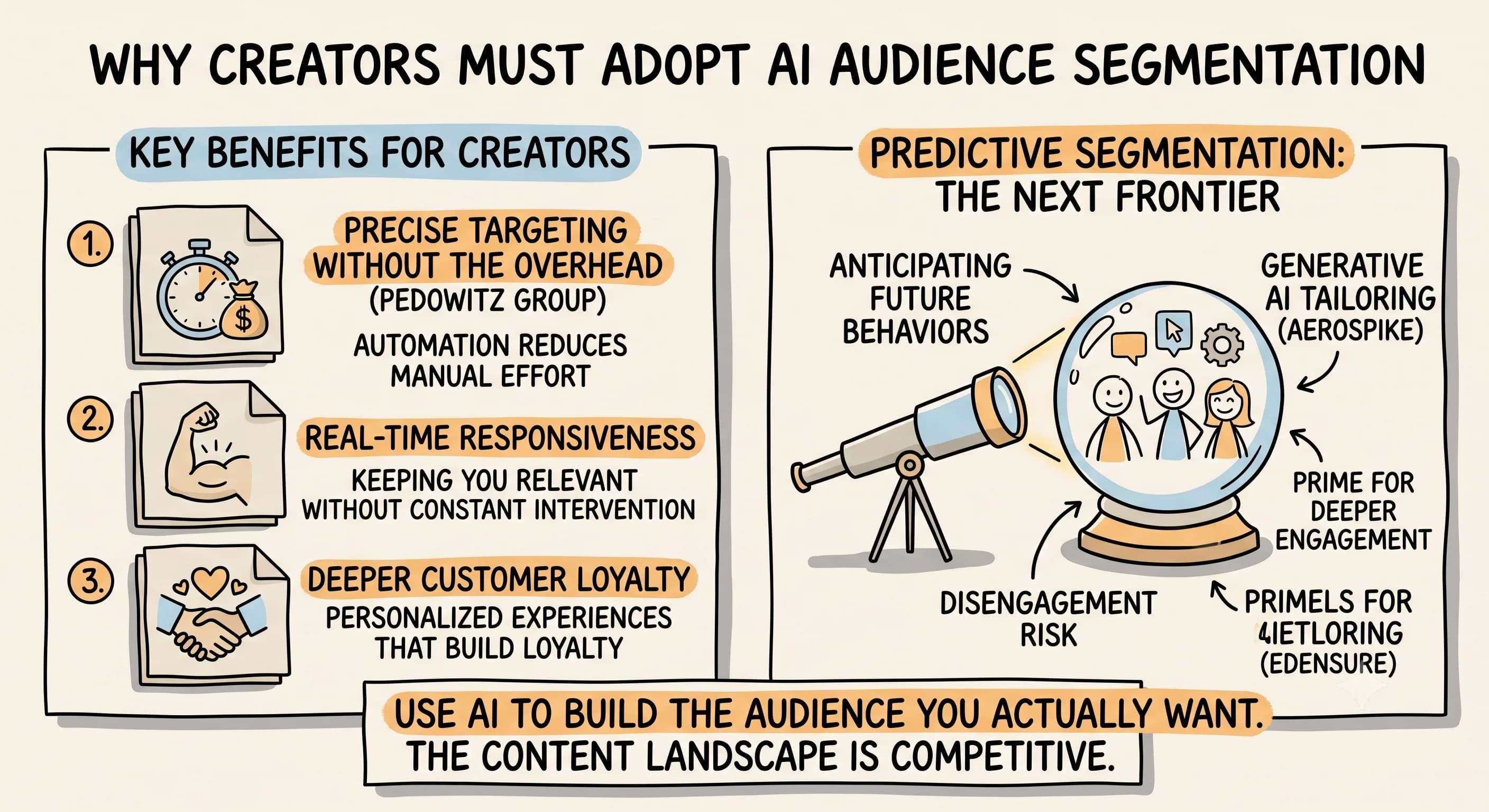
Precise Targeting Without the Overhead: Previously, precise targeting at the individual level required expensive marketing technology stacks and dedicated data teams. According to the Pedowitz Group, this capability is no longer limited to large organizations because automation and AI reduce the manual effort required to personalize at scale. Solo creators and small teams now have access to the same level of audience intelligence that large organizations use to reach their best customers.
Real-Time Responsiveness: Traditional segmentation strategies were built on historical data, meaning your content strategy was always reacting to who your audience was, not who they are right now. Real-time AI segmentation means your content adapts as your audience's interests and behaviors shift — keeping you relevant without constant manual intervention.
Deeper Customer Profiles: AI tools synthesize data across multiple touchpoints to build richer customer profiles than any manual process could produce. These profiles capture not just who your audience members are, but how they engage, what motivates them, and when they're most likely to convert.
Smarter Content Investment: When you understand which audience segments drive the most value for your creator business, you can make smarter decisions about where to focus your content energy. Rather than spreading yourself thin across every topic, you can double down on what resonates most with your best customers.
Personalized Experiences That Build Loyalty: Audiences stay when they feel seen. Delivering personalized experiences signals to your followers that you understand their specific needs — a powerful differentiator in crowded content categories across every platform.
The efficiency gains here are real. The Pedowitz Group found that AI reduced a 15-step, 15 to 25 hour segmentation-to-personalization workflow down to 4 steps and 45 to 75 minutes, while still producing personalized content variants, dynamic delivery rules, and test plans from a single core content asset. For a solo creator managing content across multiple platforms, that's not a marginal improvement. That's a structural change in how much you can accomplish.
Implementing AI Segmentation Strategies: A Step-by-Step Approach
How to Use AI for Audience Segmentation Across Platforms
Ready to put AI audience segmentation to work? Here's a practical framework built around five core steps.
Step 1: Define Your Distinct Audience Segments
Before any AI tool can help you, you need clarity on who your audience actually includes. Start by identifying the major groups within your customer base. What differentiates their needs, goals, or content preferences? Use existing analytics from your platforms — YouTube Studio, email platform reports, Instagram Insights, Spotify for Podcasters — to identify patterns in who engages with which types of content. These initial segments don't need to be perfect. They're your starting point, and AI will refine them over time.
Step 2: Identify the Right AI Segmentation Tool
Not all AI tools are built for the same use case. When evaluating an AI audience segmentation tool, look for platforms that offer real-time data processing, integration with your existing content platforms, predictive segmentation capabilities, and clear reporting on segment-specific performance. Tools like Klaviyo for email, Segment for customer data infrastructure, or platform-native AI features built into tools like HubSpot or Mailchimp's predictive analytics suite are worth exploring depending on your content ecosystem.
According to Braze, AI-driven implementation involves unifying customer data, dynamically segmenting audiences with AI, then launching automated campaigns with personalized content and timing. That sequence matters. Unifying your data first prevents the fragmented audience picture that makes segmentation unreliable.
Step 3: Create Adaptable Core Content
The efficiency of AI-driven segmentation comes from building content that can be adapted rather than entirely rewritten for each audience segment. Think of your content as having a core message and modular components — an introduction that speaks to different starting points, examples that vary by segment, calls-to-action tailored to where each group is in their journey. Braze confirms this approach: create one content base and let the rules or generative systems handle the adaptation per segment. This modular approach lets AI tools swap and customize elements without requiring you to produce entirely separate content pieces for every audience segment.
Step 4: Set Segment-Specific Parameters
Work within your chosen segmentation tool to define the rules governing how content differs across segments. This includes what signals trigger segment assignment — behavioral, demographic, engagement-based — how content elements should vary per segment, and what thresholds define movement between segments as customer behavior evolves. The more precise your parameters, the more effective your personalized experiences will be.
Step 5: Monitor and Refine Your Segmentation Logic
AI-driven segmentation isn't a set-it-and-forget-it system. According to Altudo, the right approach is to monitor engagement, conversion, and ROI by segment, then feed results back into the model for continuous refinement. Which segments show the highest engagement? Which are growing fastest? Are there emerging micro-segments you hadn't previously identified? Predictive segmentation features in advanced AI tools can surface these insights proactively, flagging shifts in customer behavior before they become trends you've already missed.
Predictive Segmentation: The Next Frontier for Content Creators
Generative AI and Customer Engagement at Scale
While real-time segmentation addresses where your audience is today, predictive segmentation uses AI to anticipate where they're going. By analyzing historical customer behavior patterns alongside broader trend data, predictive AI tools can identify which audience segments are likely to disengage, which are primed for deeper engagement, and what content types are gaining relevance before the signal is obvious in your analytics.
For content creators, generative AI adds another layer of capability. Rather than manually customizing each piece of content for different customer segments, generative AI can produce segment-specific variations automatically — adjusted in tone, depth, format, or emphasis based on the preferences of each group. According to Aerospike, real-time audience segmentation for personalization is a distinct, operationally deployable approach, not a theoretical concept. That framing is useful. These aren't aspirational tools reserved for marketing departments with six-figure software budgets. They're practical, deployable systems that individual creators can put to work across platforms today.
Across platforms — whether you're building an audience on YouTube, growing an email list, publishing a podcast, or scaling a social media presence — these AI capabilities give you the tools to engage each audience segment in ways that feel genuine and relevant, not generic.
Audience Segmentation FAQs Every Creator Should Know
 How is AI segmentation different from traditional segmentation? Traditional segmentation relies on static, manually-defined groups updated infrequently. AI segmentation is dynamic, updating customer profiles in real time based on continuous behavioral data analysis. As Averi notes, the system changes messaging and delivery in the moment as new signals arrive.
Do you need a large audience to benefit from AI audience segmentation? No. Even with a smaller but engaged audience, segmentation helps you deliver more relevant content to distinct groups, which improves retention and accelerates organic growth. A tightly segmented list of 2,000 engaged readers will outperform a disengaged list of 20,000 every time.
Which platforms support AI audience segmentation tools? Most major email marketing platforms, CRM tools, and analytics suites now include some form of AI-driven segmentation. Native platform analytics on YouTube, Meta, and Spotify also offer increasingly sophisticated audience breakdown features.
What data signals should drive segment assignment? Focus on behavioral signals over demographic ones. IBM recommends basing segmentation on behavior, preferences, and outcomes, because that data reflects how your audience actually engages, not just who they are on paper.
Conclusion: Use AI to Build the Audience You Actually Want
The content landscape is more competitive than ever, and generic broadcast content is losing the battle for audience attention every day. AI audience segmentation gives you a structural advantage: the ability to personalize experiences for distinct audience segments in real time, without requiring enterprise-level resources or a team of data analysts.
By defining your audience segments clearly, selecting the right AI tools, building adaptable core content, and monitoring segment-specific performance with a commitment to continuous refinement, you can deliver the kind of hyper-personalized experiences that turn casual followers into loyal community members — and loyal community members into your most valuable advocates.
The creators who thrive in the next chapter of content won't just be the ones who publish the most. They'll be the ones who use AI to make every audience member feel like the content was made specifically for them. Start building that advantage today.
Read more about Audience Building & Growth for Content Creators
📚 Complete Guides
- How to Build an Audience as a Content Creator
- How to Find Your Target Audience (Start With One Person)
⚡ Tactics & Strategies
- 30 Daily Outbound Pitches for UGC Deal Generation
- 50% Retention Rate Optimization for YouTube Algorithm Success
- Age Bracket as Superpower Strategy for Older UGC Creators
- Audience Consistency Strategy to Avoid Algorithm Penalties
- Audience Psychology Over Algorithm Optimization, Focusing on Human Pain Points and Goals Instead of Platform Tactics
📄 Related Articles
- How to Get More Instagram Story Views: The STD Strategy
- Questions to Ask Your Audience on Social Media (That Get Replies)
- Cold Email Outreach: A 90-Day System for Creators
- Instagram Lead Generation: The Comment-to-Get Strategy
- Influencer Gifting: The Creative Method That Wins Collabs
- Voice of the Customer: A Creator's Guide to Magnetic Messaging
- Content Creator Burnout: Signs, Prevention, and the Mindset That Fixes It
- Influencer Authenticity: How Honest Product Reviews Drive Real Influence
Read more about Systems, Workflows & Operations for Content Creators

Alex Kirillov
Details
One link. Every channel, rate, and piece of work brands need to evaluate you. Built for how creators actually get hired.
Claim your profile
Live creator, content, and marketing roles from real companies, with the pay, market, and context the raw job page never gives you.
Browse jobs