How Many Cold Emails to Send Before Analyzing Pitch Performance: The 30-Email Benchmark Rule
Find out how many cold emails to send before analyzing pitch performance. The 30-email benchmark rule stops bad data from killing your outreach strategy.
Details
How Many Cold Emails to Send Before Analyzing Pitch Performance: The 30-Email Benchmark Rule
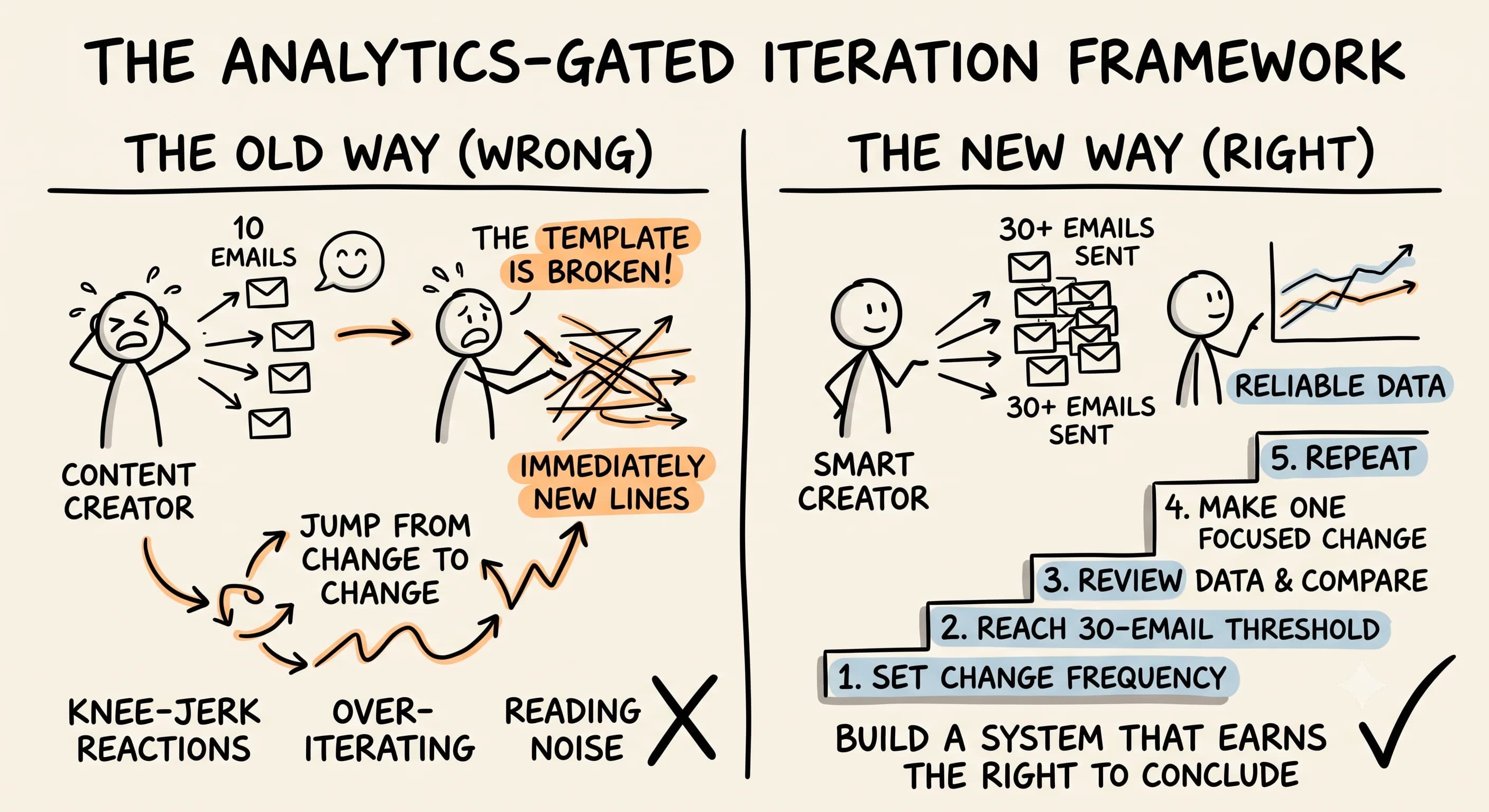
You spent three hours crafting what you believe is the perfect brand pitch. You sent it to ten potential sponsors, got one reply, and immediately concluded the template was broken. So you rewrote everything and started from scratch. Sound familiar?
This is one of the most common and costly mistakes content creators make when managing their outreach strategy. The problem isn't the pitch itself. The problem is that you drew a conclusion from data that was never statistically reliable in the first place. If you want to truly optimize your email campaign results, you need to understand the relationship between send volume, analytics review timing, and meaningful iteration.
This post breaks down the analytics-gated iteration framework that smart creators are using to finally get accurate, actionable data from their cold email outreach efforts. By the end, you'll know exactly how many cold emails to send before analyzing pitch performance, and how to build a system that actually improves your reply rate over time.
Why Most Creators Misread Their Cold Email Campaign Data
 The instinct to check your email performance immediately after sending is completely natural. You want feedback. You want to know if your outreach is working. But checking analytics too early is like reading a cake recipe after only mixing the flour and declaring it inedible.
When you review an email campaign with fewer than 30 sends per variation, you're not looking at data. You're looking at noise. A 20 percent reply rate on 10 emails sent means two people responded. That could be coincidence, timing, or the fact that those two recipients happened to be in a good mood. It tells you almost nothing reliable about your template's actual conversion rate.
The same logic applies to your open rate and subject lines. If only 10 recipients have received a particular version of your subject line, an open rate of 50 percent means five people opened it. That's not a benchmark. That's anecdote.
Statistical significance requires volume. According to Google, insufficient send volume is one of the main reasons A/B test results fail to show statistical significance, meaning low-volume reviews produce misleading conclusions. For cold email outreach, the widely accepted minimum threshold is 30 emails sent per variation before your data becomes trustworthy enough to act on.
The 30-Email Benchmark: Cold Email Best Practices for Content Creators
 So what is the 30-email rule? Simply put, it means you should send at least 30 emails using the same pitch template variation before you review your analytics or make any changes. This benchmark ensures your open rate, reply rate, and conversion rate data reflect actual patterns rather than statistical flukes.
This is especially important for content creators who are running cold outreach to brand partners, podcast sponsors, or collaboration opportunities. Unlike large sales email operations that send hundreds of emails daily, most creators are working with smaller, more targeted lists. That makes every data point count more, which is exactly why you can't afford to misread it.
It's worth noting that Klaviyo recommends at least 50 recipients per variation and a win probability of at least 90 percent before treating A/B test results as statistically significant. For creators with tighter lists who can't always hit 50 sends quickly, 30 is the practical working floor, but pushing toward 50 when your volume allows will give you even stronger confidence in what you're seeing.
Here's how the 30-email benchmark connects to commonly asked email rules:
What is the 30 30 50 rule for cold emails? This rule suggests that 30 percent of your effort goes into list building, 30 percent into personalization, and 50 percent into follow-up. While this is a separate framework, it aligns with the volume-based thinking here: meaningful results come from a systematic, volume-driven approach rather than sporadic sends.
What is the 3 21 0 email rule? This refers to sending a sequence of three emails over 21 days with a goal of zero unread messages. Again, this supports the idea that outreach is a numbers and timing game, not a one-shot event.
What is the 3 email rule? This commonly refers to limiting your follow-up sequence to three touchpoints before moving on. A followup structure like this makes even more sense when paired with proper volume thresholds, because you're building data across a complete sequence, not just a single cold message.
What is the 60 40 rule in email? This principle suggests that 60 percent of your email should focus on the recipient's needs and 40 percent on your pitch. This copywriting framework works hand-in-hand with analytics-gated iteration because once you've optimized structure and personalization, volume-based testing helps you refine the language that actually drives replies.
Analytics Cadence: Aligning Cold Outreach Reviews With Change Frequency
 Knowing when to review your cold email metrics is just as important as knowing how many emails to send. The key principle here is simple: your analytics review cadence should match the frequency at which you're making changes to your pitch.
If you update your pitch template every week, then your email performance review should happen weekly. You compare this week's reply rate and open rate against last week's, accounting for the specific changes you made.
If you update your pitch template once a month, then you measure monthly. You look at how your email campaign performed this month versus last month based on the deliberate changes you implemented.
What you should never do is review your analytics on a random schedule that has no relationship to when you made changes. That creates confusion and leads to false conclusions. You might attribute a rise in reply rate to a subject line change you made three weeks ago when it was actually influenced by a follow-up message you added last week.
Google Ads research supports this directly: experiments should run for at least four weeks to account for weekly performance cycles. This reinforces that your analytics review cadence should match your change cadence rather than reacting to whatever number appears in your dashboard on any given day.
This framework prevents two equally damaging outcomes: abandoning a working strategy too soon, or holding onto a broken one for too long.
How to Set Up Your Cold Email Metrics System as a Content Creator
 Building this system doesn't require expensive software or a dedicated operations team. Here's a practical framework you can implement today across any platform.
Step 1: Decide your change frequency. Are you iterating on your pitch weekly or monthly? Make this decision based on your current outreach volume. If you're only sending 10 to 15 emails per week, monthly reviews make more sense because you'll hit the 30-email threshold faster on a monthly basis.
Step 2: Set your analytics review date to match. If you're on a monthly cadence, block one hour at the end of each month to review your email performance. If weekly, set a recurring calendar event. Don't check your stats outside of this schedule.
Step 3: Confirm your volume threshold before reviewing. Before you open your analytics dashboard, verify that you've sent at least 30 emails with the current version of your pitch. If you haven't, skip the review and wait. Checking early will produce misleading data.
Step 4: Compare period-over-period performance. Look at your reply rate, open rate, and conversion rate from this period versus the last. Tie any changes you observe directly to the specific edits you made. Did you change your subject lines? Did you adjust the opening line? Did you add or remove a followup? Connect each metric shift to a concrete action.
Step 5: Make one focused change at a time. Before your next review period begins, implement one specific change. Testing multiple variables simultaneously makes it impossible to isolate what's driving improvement or decline in your email campaign results.
Applying This Framework Across LinkedIn and Multi-Platform Cold Outreach
For creators using LinkedIn outreach alongside traditional cold email, the same principles apply. Many creators treat LinkedIn messages as separate from their email outreach strategy, but they function similarly in terms of analytics and iteration.
If you're sending cold outreach via LinkedIn InMail or connection requests with a pitch note, you still need to hit a meaningful volume threshold before drawing conclusions about your messaging. Thirty is still the right benchmark for LinkedIn outreach as well.
On multi-platform outreach campaigns, track each channel separately. Your open rate and reply rate on email will behave differently than your response rate on LinkedIn because of inbox dynamics, deliverability differences, and recipient behavior. Don't blend your data across channels, or you'll end up with metrics that can't tell you anything useful about either platform.
Also consider send times and timing optimization when building your outreach cadence. Research consistently shows that emails sent on Tuesday through Thursday mornings tend to generate stronger engagement. However, don't test send times and message copy simultaneously. Pick one variable at a time and let your 30-email threshold play out before drawing any conclusions.
The ROI of Patience: Why Slowing Down Your Analysis Speeds Up Your Results
The counterintuitive truth about how to optimize email performance is this: the creators who see the fastest improvement are the ones who review their data less frequently and more deliberately.
When you gate your analytics reviews behind both a timing cadence and a minimum volume threshold, you force yourself to make fewer, better-informed decisions. Each change you make is based on real data, which means each iteration moves you meaningfully forward rather than in circles.
This approach also protects you from the spam trap of over-optimization. When creators constantly tweak their messages without reliable data, they often chase tactics that feel good but aren't supported by actual email performance numbers. Worse, frequent changes to your outreach can flag your sending behavior with email providers, hurting your deliverability and pushing future messages out of the inbox entirely.
Patient, volume-gated iteration keeps your cold email campaigns moving forward with evidence behind every decision.
Final Takeaway: Build a System That Earns the Right to Conclude
The answer to how many cold emails to send before analyzing pitch performance is at least 30 per variation, reviewed in sync with your change frequency. That's not just a rule of thumb. It's a framework that respects the math behind meaningful data and gives your outreach strategy the best possible chance to succeed.
Set your cadence. Hit your threshold. Compare period-over-period. Make one change. Repeat.
That's how serious content creators stop guessing and start growing.
Read more about Systems, Workflows & Operations for Content Creators
📚 Complete Guides
⚡ Tactics & Strategies
- 30 Daily Outbound Pitches for UGC Deal Generation
- 50% Retention Rate Optimization for YouTube Algorithm Success
- AI Workflow Integration for Content Reduction
- Audience Consistency Strategy to Avoid Algorithm Penalties
- Audience Poll on Instagram to Source Q&A Content in Advance of Recording
📄 Related Articles
- Content Creator Burnout: Signs, Prevention, and the Mindset That Fixes It
- Influencer Authenticity: How Honest Product Reviews Drive Real Influence
- TikTok Creator Search Insights: How to Find Content Gaps That Guarantee Views
- The AI Content Creation Workflow: Turn 37 Seconds Into 1,200 Words
- The AI Content Workflow That Cuts Production Time by 70%
- Influencer Campaign Report: How Smart Reporting Systems Build Stronger Brand Relationships
- How to Get Traffic From Pinterest: Pins That Compound for Years
- Street Interviews: The LinkedIn Strategy That Went Viral

Alex Kirillov
Details
One link. Every channel, rate, and piece of work brands need to evaluate you. Built for how creators actually get hired.
Claim your profile
Live creator, content, and marketing roles from real companies, with the pay, market, and context the raw job page never gives you.
Browse jobs