Free Content vs Paid Content: Are You Giving Away Too Much?
The creator economy is shifting. Learn why giving everything away for free hurts both your ROI and your audience's success
Details
Free Content vs Paid Content: Are You Giving Away Too Much?
You've probably felt it, that nagging worry that you're not sharing enough free content. Maybe you've watched other content creators dump their entire systems into 60-second videos while you hold back, wondering if you're being too "salesy." Here's what's actually happening: you're probably doing it right, and they're sabotaging their own success.
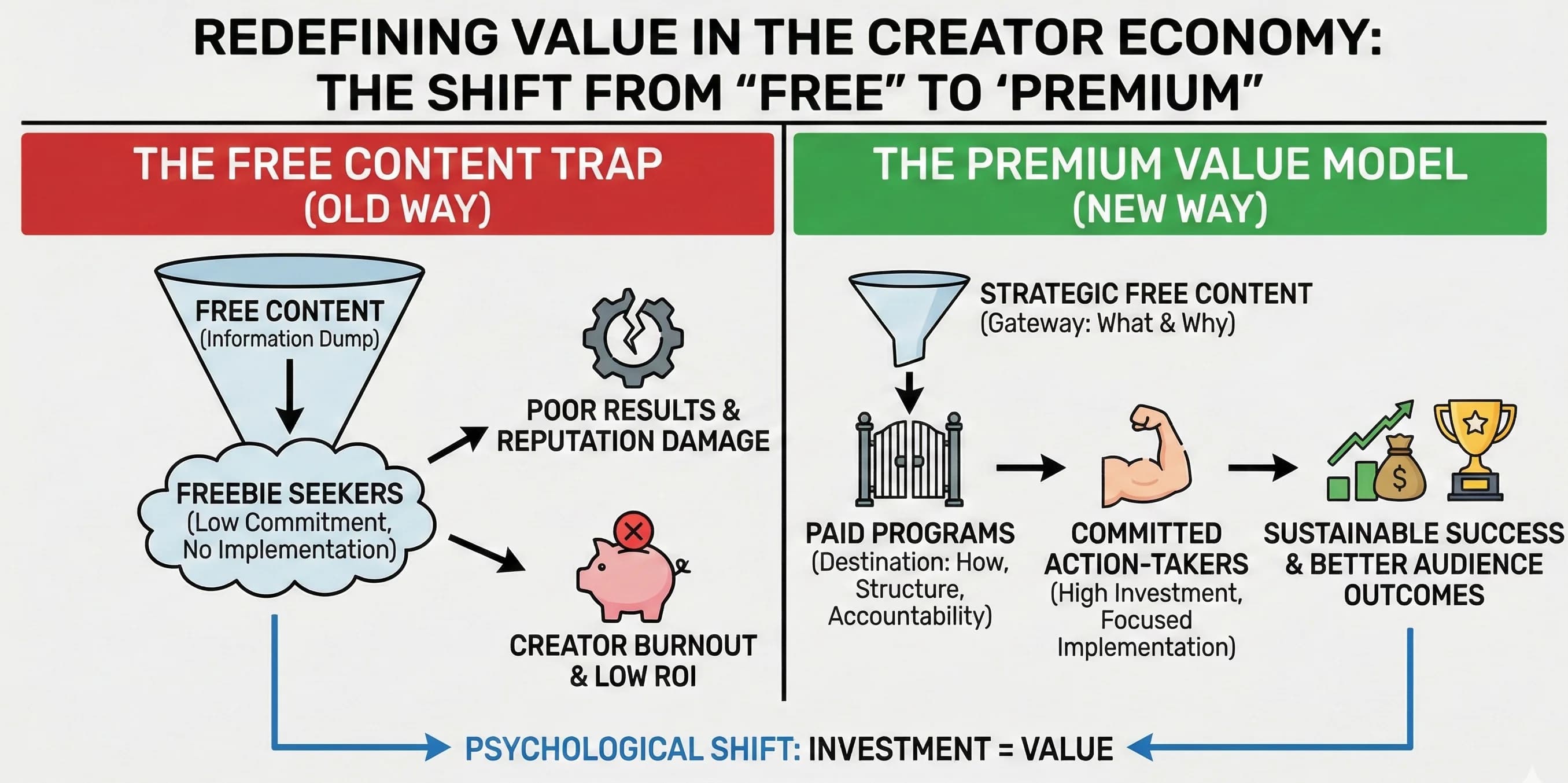
The creator economy is shifting toward a counterintuitive truth that successful influencers are already implementing. When you give away everything for free, you're not just hurting your bank account, you're actually making it harder for your audience to succeed.
A fundamental question for any online business that sells information is: what do I give away for free, and what content do I keep behind a paywall? And how much free content is too much? That's exactly what this article unpacks.
The Psychology Behind Free Content vs Paid Content
 People value what they pay for more than identical free content. This isn't just marketing theory, it's backed by solid psychological research. You could create the same PDF tutorial and offer it free versus charging $10. The person who purchases it will implement it more seriously and achieve better results.
Michal Malewicz, a successful design creator, discovered this firsthand when testing his educational content. His paid materials consistently generated better student outcomes than his free offerings, even when the information quality was identical. The difference? Investment creates commitment.
This principle completely transforms how you should think about your influencer marketing campaigns. When you constantly give away your best strategies, you're inadvertently signaling that your expertise has little worth. Your target audience begins associating free with worthless, making conversion to paid products increasingly difficult.
One of the biggest questions that any entrepreneur who sells information faces is: how can I tell the difference between my paid products and my free content? Here's a practical way to think about it. Free content gives people the "what" and the "why." Paid content gives them the structured "how," the accountability, and the environment where transformation actually occurs. That's the real difference between free and paid content, and it's worth keeping it clear in your own mind before you create content for any platform.
The structured delivery methods matter too. Your paid programs aren't just about the information, they're about accountability systems, focused implementation, and environments where transformation actually occurs. You can't replicate that level of support in a free Instagram post or a YouTube video.
Why Free Content Attracts the Wrong Following
 Traditional content marketing strategies suggest building trust through extensive free content, but this approach often backfires. You end up attracting audiences who never intend to purchase anything. These followers consume your content without implementing it properly, leading to poor results that can damage your reputation.
There is too much free content everywhere online, so why would somebody trust that your free content is the content they should be taking action on? That's the real problem with giving away high-quality content indiscriminately: it gets lost in the noise, and the people consuming free content never quite commit to doing anything with it.
Think about it. When someone gets your system for free, what's their motivation to actually use it? They haven't invested anything, so they don't lose anything by ignoring it. But when they pay, even just $10, they're psychologically committed to getting their money's worth. People are simply more likely to get results from paid products than from free content, and that's not a flaw in your audience, it's human nature.
The engagement paradox is real. Creators who focus on relationship-building rather than information dumping often see their engagement rate improve significantly. Your audience doesn't need another generic tutorial, they need to know you can actually help them solve their specific problem.
But is it really helping people to simply entertain them rather than helping them solve a problem? Not really. Valuable content that addresses a real pain point will always outperform content like a viral trick that gets views but changes nothing. If you can clearly understand and address their problems with your free content, they're thinking: "How great must the paid content be?"
Successful influencer marketing industry leaders understand that their premium programs represent the best way to help clients achieve results. The structure, accountability, and focused implementation create environments where transformation actually occurs.
How to Decide What Content to Give Away for Free vs Paid Content
 So, what should you give away as free content and what should you keep as paid content? Smart creators are redefining their content creation approach by establishing clear boundaries. Instead of revealing complete systems in free content, they're getting strategic about what they share and how they share it.
Here's a simple way to decide what content belongs where:
- Free content: the problem, the mindset shift, the overview, the inspiration. A blog post, a TikTok tip, a free vs paid breakdown in a newsletter, a podcast episode that names the issue.
- Paid content: the step-by-step system, the templates, the live coaching, the community, the accountability. A course, a masterclass, a membership, a done-with-you program.
When you decide which content goes free and what content gets gated, align it with your business goals. Free content should drive organic traffic, build your email list, and establish trust. SEO-optimized blog posts, a YouTube video that answers a burning question, sponsored content partnerships, and ads and organic content working together are all tools that serve the top of your funnel. Paid products serve the people who are ready to go deeper.
Highlight value without giving everything away. Share enough to build trust and demonstrate expertise while maintaining curiosity about your premium offerings. Show the "what" and "why," but save the detailed "how" for paying customers.
For example, you might share that mindset work is crucial for business success (the what) and explain why limiting beliefs hold people back (the why), but keep your specific 7-step mindset transformation process for your paid program. That single piece of content can do a lot of heavy lifting without cannibalizing what's behind the paywall.
Will free content cannibalize paid content? Only if you give away the exact same thing. The type of content you offer for free and what content you charge for should solve the same problem at different depths. There's healthy overlap in topic, but not in execution or completeness.
Free and Paid Content: Organic vs Paid Ads
It's worth separating two things that often get confused: free vs paid in terms of what you charge your audience, and paid ads vs organic content in terms of how you promote your work.
Paid ads can amplify your free content to reach cold audiences faster than organic traffic alone. Organic traffic from SEO, referrals, and word of mouth builds over time and compounds. Most sustainable businesses use both: paid ads to accelerate, and organic content to build lasting authority. Neither is a replacement for the other, and neither is a replacement for having a genuinely useful product or service behind it all.
The question of how much content should you give away for free also connects here. If you're relying heavily on paid ads to get sales right away, you might not need as much free content volume. But if you're building long-term through content marketing and organic traffic, your free content is doing more of the trust-building work, and you need to decide what free and what content stays gated even more carefully.
Partnership Opportunities and Authentic Marketing
This value redefinition strategy opens new doors for brands wanting to partner with influencers. When you maintain premium positioning, you become a more attractive collaboration partner. Brands recognize that influencers who value their expertise appropriately can amplify marketing messages more effectively.
Authenticity doesn't mean giving everything away. It means being honest about what level of support truly helps people succeed. Many creators discover that their most authentic content comes from sharing their journey and insights, not from trying to cram entire courses or a masterclass worth of material into social media posts.
Sponsored content is another form of paid content that works when it's genuinely aligned with your audience's interests. The same principle applies: if the product or service you're promoting doesn't actually help your audience, it erodes the trust that your free stuff has built.
When you respect your own expertise enough to charge for it, you're modeling healthy boundaries for your audience. You're showing them that valuable skills and knowledge deserve compensation, a lesson many creators need to learn themselves.
Premium positioning attracts premium partnerships. Brands want to work with creators who understand their worth and can command respect from their audiences. When you consistently undervalue your content, you signal to potential partners that you might undervalue their products too.
Marketing Strategies That Resonate in the Creator Economy
The most successful creators use free content strategically. They understand that free content is not a destination, but a gateway to build relationships, demonstrate expertise, and create advancement opportunities without providing complete solutions. This approach respects both the creator's expertise and the audience's investment in their own success.
Free content gives people a taste, not the whole meal. Your videos, Instagram posts, and other content should demonstrate your expertise while making it clear that the real transformation happens in your paid programs.
Results speak louder than free tutorials. Instead of sharing every step of your process, share the results your paying clients achieve. Social proof from people who've invested in working with you carries more weight than another "how-to" post.
Create scarcity around your attention. When everything you know is freely available online, your time and personalized guidance become the most valuable commodities you offer. Make it clear that direct access to you requires investment.
Now it's your turn: what content might you offer for free, and what might be worth charging for? Use the framework here to decide what content to keep public and what deserves a price tag. The balance between free and paid content is one of the most important strategic decisions you'll make.
As the influencer marketing landscape evolves, creators who embrace this value redefinition will build more sustainable businesses while genuinely helping their audiences achieve better results through meaningful investment in their growth. You're not being greedy when you charge for your expertise, you're creating the conditions where real change can happen.
The creators thriving won't be the ones giving content away for free without a strategy. They'll be the ones who understand that true value comes from commitment, structure, and investment, both yours and your audience's.
Read more about Monetization & Business Models for Content Creators
📚 Complete Guides
- Content Creator Monetization: Proven Revenue Streams
- Content Creator Income Streams: 7 Ways to Build Financial Stability
⚡ Tactics & Strategies
- 30 Daily Outbound Pitches for UGC Deal Generation
- Affiliate Code Negotiation Using Membership Audience Influence
- Age Bracket as Superpower Strategy for Older UGC Creators
- B2B Merchandise Bulk Sales to Industry Professionals- Packaging Products as Client Gifts for Lawyers and Service Providers
- Becoming Your Own Sponsor by Plugging Your Offer Within Episodes
📄 Related Articles
- Brand Deals on Instagram: How to Get Them Under 10K Followers
- Podcast Monetization Strategies: Earn From Episode One
- How to Negotiate Brand Deals as a Content Creator Using Your Membership Audience
- How to Optimize Your Newsletter Landing Page to Get More Subscribers
- Newsletter Sponsorship: Design Sections Sponsors Want
- How to Create a Lead Magnet That Converts: The Research Report Playbook
- How to Get More Reach on Instagram: The Email List Timing Trick
- Influencer Outreach: The DM-to-Email Method That Works
🧮 Calculators
Free: The Value Positioning Playbook
Get the interactive tool, downloadable PDF, and Notion template - all free.
No spam. Unsubscribe anytime.

Alex Kirillov
Details
One link. Every channel, rate, and piece of work brands need to evaluate you. Built for how creators actually get hired.
Claim your profile
Live creator, content, and marketing roles from real companies, with the pay, market, and context the raw job page never gives you.
Browse jobs