How to Set Up an Automated Email Funnel to Sell Digital Products (Step-by-Step Guide for Creators)
Learn how to set up an automated email funnel to sell digital products with this step-by-step creator guide. Build once, earn consistently, and scale smart.
Details
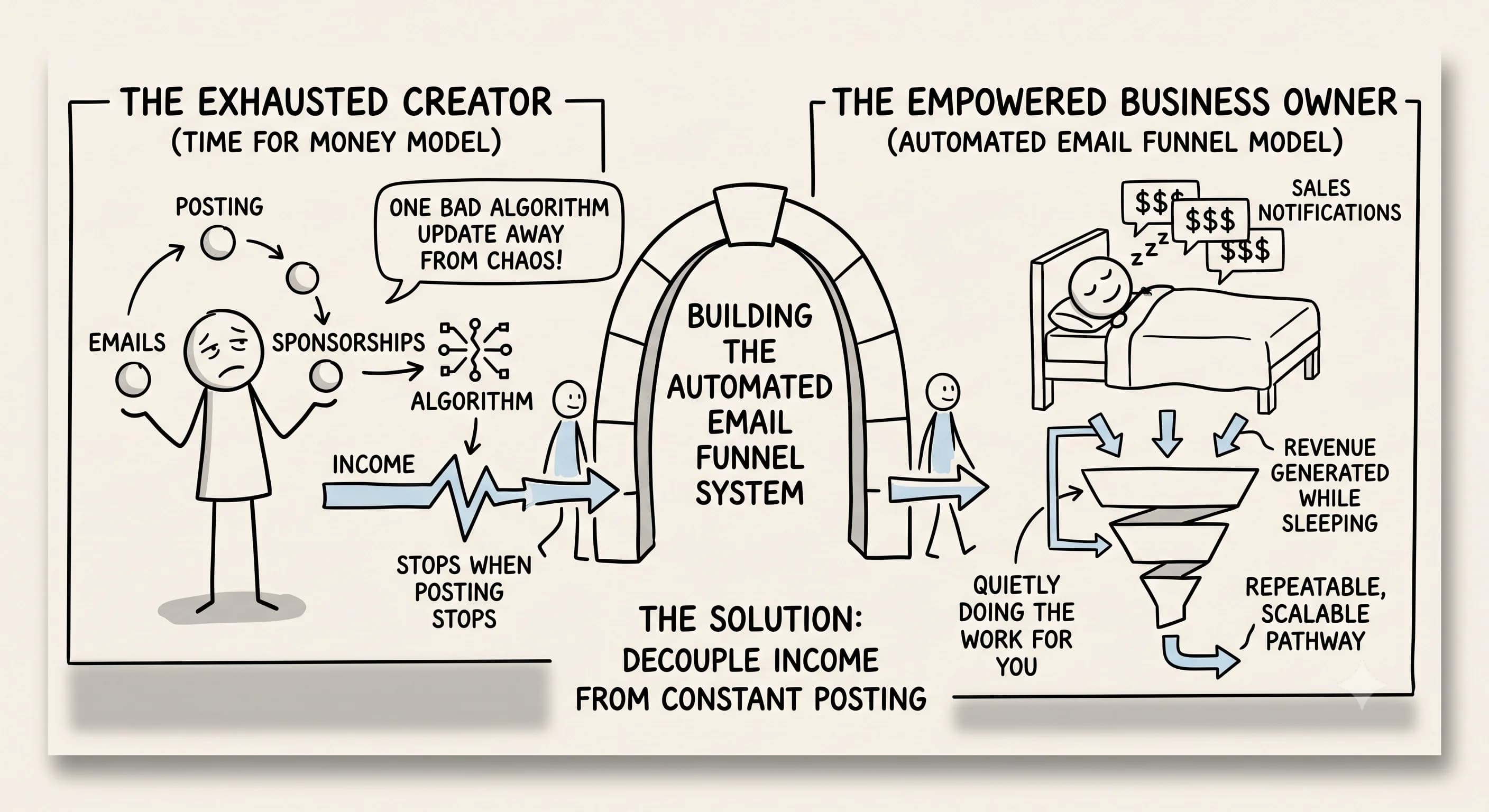
Imagine waking up to sales notifications on your phone — revenue generated while you were sleeping, not because you posted a viral video or sent a frantic last-minute email blast, but because a system you built months ago is quietly doing the work for you. This is not a fantasy reserved for six-figure influencers. It is the operational reality that content creators reach when they stop trading time for money and start building automated infrastructure.
The hard truth about the creator economy is that most creators are one bad algorithm update away from financial chaos. When posting stops, income stops. When engagement dips, revenue dips. This fragility is not a content problem — it is a systems problem. And the solution is a well-designed automated email marketing funnel that sells your digital products around the clock, independent of how often you post.
This guide breaks down exactly how to build that system, step by step, so you can transition from exhausted creator to empowered business owner.
Why an Automated Sales Funnel Changes Everything for Creators
Most creators earn income through platform-dependent revenue: ad revenue, sponsorships, and affiliate commissions tied directly to content performance. The moment you take a break, travel, get sick, or simply burn out, the income machine stalls. This is the fundamental flaw in a time-for-money model.
An automated sales funnel solves this problem by creating a repeatable, scalable pathway that moves potential customers from awareness to purchase without requiring your daily involvement. Once built, your email marketing funnel works continuously — nurturing subscribers, building trust, and converting leads into buyers whether you are actively posting or not.
According to ConversionMinded, the biggest advantage of an automated email funnel is decoupling income from constant posting. But that decoupling comes from intentional system design, not from eliminating work entirely. You still build the thing. You still write the emails. The difference is that you do it once, and then the system runs.
The strategic shift here is profound: instead of being a creator who produces content to earn money, you become a business owner who uses content to feed a system that earns money. Your content becomes the top of a marketing funnel, not the entire revenue model.
How to Create a Sales Funnel for Digital Products
 Building a digital product funnel starts with understanding the core journey your subscriber takes — from stranger to buyer. This journey has four stages: attract, capture, nurture, and convert.
Before you start writing emails or designing landing pages, do one thing first. According to Sproutbox, auditing your list, mapping the customer journey, and building your welcome sequence first is the foundation of a sustainable funnel. It sounds basic, but most creators skip straight to the sales pitch and wonder why nothing converts.
Stage 1 — Attract with a Lead Magnet
A lead magnet is a free, high-value resource that solves a specific, immediate problem for your target audience. Think templates, checklists, mini-courses, swipe files, or short guides. The key is specificity: the best lead magnets solve one problem exceptionally well rather than trying to cover everything.
For example, if you are a content creator teaching email marketing, your lead magnet might be a "7-Day Email Sequence Template for Digital Product Sellers" — immediately useful, highly relevant, and a natural bridge to your core product.
According to ConversionMinded, creators who build funnels that actually convert use lead magnets, blog posts, and traffic sources to capture subscribers before selling. The lead magnet is not just a freebie — it is the entry point of a structured system designed to move subscribers toward a purchase without manual follow-up.
Your lead magnet lives on a landing page designed with one goal: capturing the email address. Keep the landing page focused, benefit-driven, and free of distractions. No navigation menus. No unrelated links. Just a compelling headline, three to five bullet points highlighting what the subscriber gains, and an opt-in form.
Stage 2 — Capture and Tag Subscribers
When someone opts in, they become a subscriber in your email marketing platform. This is where your automation begins. Use tags or segments to identify what lead magnet they downloaded, what page they came from, and what interests they indicated. This data powers personalization later in the funnel, which directly improves your conversion rate.
Popular platforms like ConvertKit, ActiveCampaign, and Mailchimp all support tagging and automation. Choose a platform that lets you build visual automation workflows so you can map out your entire email funnel before you write a single email.
How to Build an Automated Sales Funnel with an Email Sequence
Once your subscriber is captured, the automated email sequence takes over. This is the heart of your marketing automation — a pre-written series of emails that delivers value, builds trust, and introduces your digital product naturally.
According to ActiveCampaign, effective funnels treat email marketing as a revenue system built from segmentation, personalization, and behavior-based automation — not a one-off campaign. That distinction matters. A one-off campaign is something you manage. A system is something that runs.
The Anatomy of a High-Converting Email Sequence
 A foundational nurture sequence typically spans five to seven emails delivered over one to two weeks. Here is a proven structure:
Email 1 — Welcome and Deliver: Send immediately upon opt-in. Deliver the lead magnet, set expectations for what is coming, and introduce yourself briefly. Keep it warm and human.
Email 2 — The Origin Story: Share why you created your solution and what problem you personally experienced. This is where you build trust by being relatable and credible.
Email 3 — Teach and Solve: Deliver a genuinely useful lesson or insight related to your subscriber's core problem. No pitch. Pure value. This email does more for your conversion rate than most creators realize — it demonstrates expertise and earns goodwill.
Email 4 — Social Proof: Share case studies, testimonials, or transformation stories from people who have used your methods or products. Real results from real people are among the most powerful trust-builders in digital marketing.
Email 5 — Introduce the Product: Now, with trust established, introduce your digital product as the natural next step. Frame it as a solution, not a sale. Explain what it solves, who it is for, and what results it produces.
Email 6 — Handle Objections: Address the most common reasons people hesitate: price, time, skepticism, or relevance. Use FAQ-style content or mini case studies to dissolve resistance.
Email 7 — Urgency and CTA: Create a clear call to action with a time-sensitive incentive if appropriate — a bonus, a limited discount, or a closing deadline. Make it easy to buy with a direct link to your sales page.
According to EmailStorySelling, a four-stage funnel structure — lead magnet, tripwire, core offer, and upsell — shows how creators can monetize subscribers continuously with automated stages. If you want to maximize revenue from every subscriber, consider adding a low-cost introductory product between your lead magnet and your core offer. It lowers the barrier to a first purchase and builds buyer trust before the bigger ask.
Optimizing Subject Lines and Open Rates
Even the best email sequence fails if nobody opens the emails. Subject lines are your first and most critical conversion point. To optimize open rates, write subject lines that trigger curiosity, promise a specific benefit, or speak directly to a pain point. Avoid clickbait — your subscribers will lose trust quickly if the email does not deliver on the subject line's promise.
Test two subject line variations using A/B testing features available in most email platforms. Over time, these small optimizations compound into significantly higher open rates and more product sales.
How to Create an Email Sales Funnel That Converts Consistently
The difference between a funnel that converts and one that collects dust lies in how well it addresses the subscriber's specific situation. Personalization is the engine of a high-performing automated funnel.
Segment to Personalize the Marketing Funnel
Not every subscriber has the same problem or is at the same stage of awareness. Use segmentation to send more relevant content. For example, a subscriber who downloaded a beginner-level lead magnet should receive a different email sequence than someone who opted in via an advanced topic. When your emails feel personally relevant, your conversion rate climbs naturally.
According to Automateed, the most operationally effective digital product funnels use automation plus segmentation across welcome sequences, cart abandonment, post-purchase follow-ups, and win-back campaigns. Most creators only set up the welcome sequence and stop there. Building out even one additional automated sequence — like a cart abandonment email — can meaningfully recover lost revenue without any extra effort on your end.
Connect Your Email Funnel to Evergreen Digital Products
For your automated funnel to generate truly passive revenue, the digital products at the end must be evergreen — meaning they solve problems that do not expire. Online courses, eBooks, templates, toolkits, and membership subscriptions all qualify.
Automateed also notes that membership or subscription models can be layered on top of automated email sales to stabilize recurring revenue. If you already have a core digital product, a subscription tier or membership is one of the most efficient ways to create predictable monthly income from the same funnel infrastructure.
Once your digital product exists, it can be sold continuously through your funnel without requiring you to create new content. According to Automateed, an evergreen creator funnel built around a registration page, email sequence, webinar replay, and sales page is a direct example of automated selling that operates independently of your posting cadence. You build it once, optimize it periodically, and it generates revenue indefinitely.
Can You Sell Digital Products on ClickFunnels?
Yes — ClickFunnels is a popular platform specifically designed to build sales funnels for digital product sellers and ecommerce businesses. It includes landing page builders, order forms, one-click upsells, and email automation features. However, for creators already using an email marketing platform like ConvertKit or ActiveCampaign, integrating those tools with a simple sales page may be more cost-effective and flexible. The platform you choose matters less than the strategy and sequence you build inside it.
How to Set Up an Automated Sales Funnel: The Operational Checklist
 Ready to build your system? According to Automateed, the smartest approach is to launch a minimum viable funnel first, measure your opt-in and conversion rates, and then refine the weakest step. Don't wait until everything is perfect. A simple funnel that's live and generating data is worth more than a perfect funnel that's still in a Google Doc.
Use this checklist to set up an automated sales funnel that runs independently of your posting schedule:
- Create your lead magnet — solve one specific problem for your ideal subscriber
- Build your landing page — one goal, one opt-in, zero distractions
- Set up your email platform — configure tagging, automation triggers, and sequences
- Write your five to seven email nurture sequence — value first, pitch later
- Develop your evergreen digital product — course, template, toolkit, or membership
- Create your sales page — clear headline, benefits, testimonials, and a direct CTA
- Connect your funnel — link landing page to email platform, email platform to sales page
- Test the entire flow — opt in yourself, receive every email, click every link
- Monitor and optimize funnel performance — track open rates, click rates, and conversion rate monthly
ConversionMinded describes a concrete first-sale funnel structure that includes a premium offer, a low-cost intro product, lead magnets, funnel content, traffic, and a closing email sequence. If you're building from scratch, use that as your mental model. Start lean, then layer in complexity as you learn what's working.
Scaling the System: Hiring Support to Protect Your Automation
Building the funnel is only the beginning. Long-term sustainability requires that you protect and grow the system without burning out. As your subscriber list grows and your product sales increase, your operational demands will too.
This is where hiring support becomes a strategic move, not an expense. According to Automateed, outsourcing recurring tasks such as editing, planning, social media management, and customer service preserves creator bandwidth so the system can scale without burnout. Bringing on a virtual assistant for customer service, a video editor for top-of-funnel content, or a copywriter to refresh your email sequence frees you to focus on high-level strategy — creating new products, expanding to new audiences, and optimizing your marketing funnel for better performance.
Your funnel does not take days off, and neither should the support systems around it. Consistency is what separates a funnel that compounds over time from one that flatlines after the initial setup.
Start Building Your Email Funnel Today
The creator economy rewards systems-thinkers. While most creators are chasing the next viral post, the most sustainable creators are quietly building automated infrastructure that generates revenue independent of any single platform or posting schedule.
Your email marketing funnel is that infrastructure. It builds trust with potential customers, delivers your digital product on autopilot, and decouples your income from your output. Start with one lead magnet, one landing page, and one email sequence. Build from there.
The best time to set up an automated email funnel to sell digital products was the day you launched your first digital product. The second best time is today.
Read more about Monetization & Business Models for Content Creators
📚 Complete Guides
- Content Creator Monetization: Proven Revenue Streams
- Content Creator Income Streams: 7 Ways to Build Financial Stability
⚡ Tactics & Strategies
- 30 Daily Outbound Pitches for UGC Deal Generation
- Affiliate Code Negotiation Using Membership Audience Influence
- Age Bracket as Superpower Strategy for Older UGC Creators
- B2B Merchandise Bulk Sales to Industry Professionals- Packaging Products as Client Gifts for Lawyers and Service Providers
- Becoming Your Own Sponsor by Plugging Your Offer Within Episodes
📄 Related Articles
- Content Creator Burnout: Signs, Prevention, and the Mindset That Fixes It
- Influencer Authenticity: How Honest Product Reviews Drive Real Influence
- TikTok Creator Search Insights: How to Find Content Gaps That Guarantee Views
- The AI Content Creation Workflow: Turn 37 Seconds Into 1,200 Words
- The AI Content Workflow That Cuts Production Time by 70%
- Influencer Campaign Report: How Smart Reporting Systems Build Stronger Brand Relationships
- UGC Usage Rights Explained: What to Charge and How to License
- Usage Rights Pricing: How Content Creators Can Maximize Revenue from Brand Partnerships
🧮 Calculators
Read more about Systems, Workflows & Operations for Content Creators

Alex Kirillov
Details
One link. Every channel, rate, and piece of work brands need to evaluate you. Built for how creators actually get hired.
Claim your profile
Live creator, content, and marketing roles from real companies, with the pay, market, and context the raw job page never gives you.
Browse jobs