How to Use Google Trends and Ahrefs to Plan Podcast Episodes That Rank
Learn how to use Google Trends and Ahrefs to plan podcast episodes that rank. A step-by-step keyword research workflow for podcast SEO growth.
Details
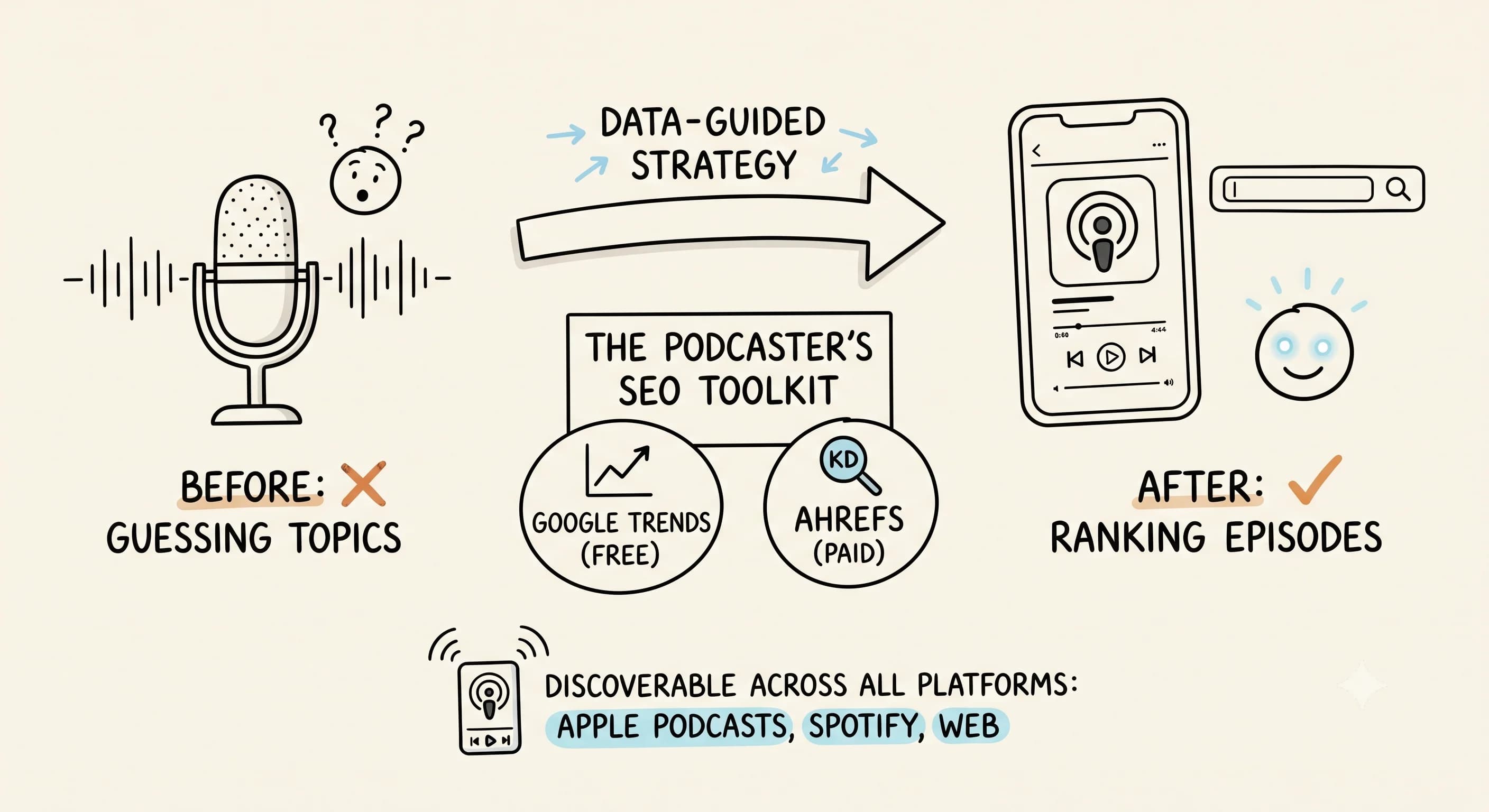
You've recorded dozens of podcast episodes, poured hours into editing, and crafted what you believe are compelling topics yet your downloads stay flat. The uncomfortable truth is that great content alone doesn't build an audience. Discoverability does. And in 2026, discoverability means understanding exactly what your potential listeners are already searching for before you hit record.
This is where keyword research for podcast planning becomes your secret weapon. By combining the power of free and paid keyword research tools, you can validate episode ideas, optimize your content for search engines, and dramatically increase your podcast's visibility across every major platform. Whether you're publishing on Apple Podcasts, Spotify, or your own podcast website, the strategy is the same: let data guide your content decisions.
Why Podcast SEO Matters More Than Ever
The podcasting landscape has never been more competitive. There are over five million active podcasts globally, and that number keeps climbing. At the same time, search engine optimization has evolved beyond traditional blog posts and web pages. AI search tools are now surfacing podcast content directly in search results, and directories like Apple Podcasts have their own internal search algorithms that reward well-optimized episodes.
Podcast SEO in 2026 isn't optional. It's essential. Every episode title, show notes description, and piece of written content you publish is an opportunity to rank in search results and attract listeners who are actively looking for answers you provide. Without an intentional SEO strategy, even your best episodes stay hidden.
Keyword research is the foundation of that strategy. When you know which keywords your audience is typing into Google search, Apple Podcasts, or AI search tools, you can reverse-engineer your content to meet them exactly where they are.
What Are Keyword Research Tools and Why Do You Need Them?
Keyword research tools help you understand the language your audience uses when searching for content online. Instead of guessing which topics resonate, you get real data including search volume, trending interest, competitor analysis, and more.
For podcasters focused on audience building, these tools answer critical questions:
- What topics are people actively searching for right now?
- How many people search for a specific term each month?
- What content is already ranking for those keywords?
- Are your competitors capitalizing on gaps you're missing?
The two most powerful tools in a podcaster's SEO toolkit are Google Trends and Ahrefs. One is free and perfect for quick validation. The other is a paid powerhouse built for deep competitive analysis. According to Ahrefs, these two tools are explicitly positioned as complementary for content planning, with Google Trends best for broad topic discovery and understanding what's rising, and Ahrefs Keywords Explorer better for accurate search volume, keyword difficulty, and SERP analysis. Together, they give you everything you need to craft episodes that both serve your audience and rank in search.
How to Use Google Trends for Podcast Episode Planning
 Google Trends is your starting point for any keyword research process. It's completely free, incredibly intuitive, and gives you immediate insight into whether a topic is gaining or losing momentum in Google search.
Here's how to use Google Trends effectively for podcast planning:
Step 1: Enter Your Episode Concept Head to Google Trends and type in the keyword or phrase that represents your episode idea. For example, if you're planning a podcast episode about remote work productivity, type in "remote work productivity" and review the interest-over-time graph.
Step 2: Analyze Trending Direction The graph shows you whether search interest is trending up, trending down, or staying flat. You want topics with upward momentum or consistent, sustained interest. This tells you people are actively searching and that trend is likely to continue. Lite14 recommends checking Google Trends weekly or monthly to stay ahead of audience interest shifts, watching for spikes, declines, and regional interest patterns that can shape when and how you cover a topic.
Step 3: Compare Multiple Keywords Google Search Central recommends adding up to five terms in the Explore tool to compare relative search interest over time and across regions. Use this to test different angles on the same topic. "Remote work tips" versus "work from home productivity" might tell very different stories about what your audience prefers.
Step 4: Explore Related Queries Scroll down to find "Related Queries" and "Related Topics." Google Search Central specifically suggests using "Top" to see what already has established interest and "Rising" to spot topics that are gaining attention right now. Ausha's podcast keyword research workflow recommends extracting five to ten highly relevant search phrases from the Related Queries section and then cross-referencing them against competitor content to identify keywords that appear in listener queries but aren't being used by bigger shows, which creates genuine strategic opportunities for newer podcasters.
What Are the Limitations of Using Google Trends?
Google Trends is powerful but incomplete. It shows relative search interest rather than exact search volume numbers, so you can't tell if a trending topic gets 100 searches per month or 100,000. It also doesn't show you competitor data, backlink profiles, or content performance metrics. That's where Ahrefs becomes indispensable.
How to Use Ahrefs for Deeper Keyword Research and Podcast SEO Strategy
 Ahrefs is a paid SEO tool that gives you granular data unavailable anywhere else. For podcasters serious about building an audience through organic search, the investment pays for itself quickly.
Here's how to use Ahrefs to optimize your podcast content:
Search Volume Analysis Unlike Google Trends, Ahrefs gives you exact monthly search volume for any keyword. This lets you prioritize high-traffic opportunities and avoid investing time in topics with minimal search interest. Captivate advises picking podcast episode topics by search intent, then choosing the keyword with the highest search volume for each subtopic and using it in the episode title and on-air content to drive more listeners finding your show via search.
Competitor Content Strategy Type a competitor's podcast website into Ahrefs' Site Explorer to see which keywords are driving their traffic. You'll discover which episode topics and written content pieces are performing best and find gaps where you can create something better. Calico Content recommends using Ahrefs specifically to operationalize competitor analysis, combining it with Google Trends data to balance search volume with audience relevance when prioritizing episode topics.
Keyword Difficulty Scoring Ahrefs scores every keyword by how difficult it is to rank for. As a newer or mid-size podcast, targeting lower-difficulty keywords with solid search volume often produces faster, more meaningful results than chasing high-competition terms.
Content Gap Analysis Use Ahrefs' Content Gap tool to compare your podcast website against competitors and find keywords they're ranking for that you're missing entirely. Each gap is a potential podcast episode waiting to happen. According to Ahrefs, Keywords Explorer and Site Explorer provide keyword difficulty, the number of SERP features, and top-ranking pages, which are crucial for strategic content decisions that free tools like Google Trends alone simply cannot provide.
Is There a Better Tool Than Google Trends?
For raw trending data and geographic interest breakdowns, Google Trends remains unmatched, especially because it's free. However, for comprehensive keyword research, Ahrefs and alternatives like SEMrush or Google Keyword Planner provide deeper, more actionable data. Google Keyword Planner, available through Google Ads, also offers free search volume ranges and new keyword ideas worth exploring before committing to a paid tool.
Essential Podcast SEO Best Practices: Turning Your Keyword Research Into Action
Gathering data is only valuable if you apply it. Here's how to translate your keyword research findings into a comprehensive SEO strategy for your podcast:
Optimizing Your Podcast Title and Episode Title
 Your podcast title and episode title are prime real estate for high-value keywords. Search engine algorithms across Google, Apple Podcasts, and Spotify all weight titles heavily. Include your right keywords naturally and don't keyword-stuff, but don't leave them out either.
For example, instead of "Episode 47: My Conversation with Jane," try "Productivity Secrets for Remote Teams with Jane Smith | Episode 47." The second version targets specific search terms while still being human-readable. Podsqueeze recommends incorporating the main keyword into the episode title, show notes page title, and URL slug while avoiding keyword stuffing, keeping each placement purposeful and natural.
Improving Your Show Notes With Targeted Keywords
Show notes are written content that lives on your podcast website and often syndicates to podcast directories. They're indexed by search engines and directly impact your rankings in search results.
Write detailed, keyword-rich show notes for every episode. Aim for at least 300 to 500 words, naturally incorporating your target keywords and related terms. Include timestamps, resource links, and clear calls to action to improve user engagement and dwell time.
Promoting Your Podcast Through Multi-Platform Optimization
 Don't limit your SEO strategy to your podcast website. Optimizing your podcast across all platforms amplifies your reach:
- Apple Podcasts: Use your target keyword in your show description and episode descriptions
- Spotify: Complete all metadata fields with keyword-rich descriptions
- YouTube: If you publish video content, optimize titles, descriptions, and tags
- Blog posts: Convert each episode into a standalone blog post targeting your primary keyword for an additional search entry point
The Recommended Keyword Research Workflow for Podcast Episode Planning
The most effective approach follows a specific sequence. According to Ahrefs, the recommended workflow is to use Google Trends' Interest Over Time to spot whether a topic is growing or declining, then use Related Queries with the Top and Rising filters to discover new keyword ideas, and then qualify those topics with a keyword tool for search volume and difficulty before investing in content production.
Here's how to run that workflow before recording every single episode:
- Brainstorm your episode concept based on your audience's pain points and interests
- Use Google Trends to validate the concept and check trending direction using Interest Over Time
- Check Related Queries using both Top and Rising filters to find new keyword angles
- Use Ahrefs or Google Keyword Planner to find exact search volumes, keyword difficulty scores, and competitor content
- Refine your episode angle to align with high-volume, lower-competition keyword opportunities
- Build your episode title around your primary keyword naturally
- Write comprehensive show notes that incorporate your target keywords and related terms
- Repurpose the episode into a keyword-optimized blog post for additional search visibility
This isn't a one-time exercise either. Making this a consistent habit, whether weekly or monthly, keeps your podcast content aligned with what your audience is actually searching for as trends shift.
Audience Building Starts With Being Found
The podcasters who grow consistently aren't necessarily the most talented. They're the most discoverable. By integrating keyword research tools like Google Trends and Ahrefs into your episode planning process, you shift from creating content you hope people find to creating content you know people are searching for.
Keyword research for podcast planning isn't about gaming the system. It's about speaking your audience's language, meeting them where they already are, and making sure your podcast shows up when they need it most. Start with Google Trends today, invest in Ahrefs when you're ready to go deeper, and watch your podcast SEO strategy transform your audience growth from wishful thinking into a predictable, data-driven engine.
Read more about Systems, Workflows & Operations for Content Creators
📚 Complete Guides
⚡ Tactics & Strategies
- 30 Daily Outbound Pitches for UGC Deal Generation
- 50% Retention Rate Optimization for YouTube Algorithm Success
- AI Workflow Integration for Content Reduction
- Audience Consistency Strategy to Avoid Algorithm Penalties
- Audience Poll on Instagram to Source Q&A Content in Advance of Recording
📄 Related Articles
- Content Creator Burnout: Signs, Prevention, and the Mindset That Fixes It
- Influencer Authenticity: How Honest Product Reviews Drive Real Influence
- TikTok Creator Search Insights: How to Find Content Gaps That Guarantee Views
- The AI Content Creation Workflow: Turn 37 Seconds Into 1,200 Words
- The AI Content Workflow That Cuts Production Time by 70%
- Influencer Campaign Report: How Smart Reporting Systems Build Stronger Brand Relationships
- How to Get Traffic From Pinterest: Pins That Compound for Years
- Street Interviews: The LinkedIn Strategy That Went Viral

Alex Kirillov
Details
One link. Every channel, rate, and piece of work brands need to evaluate you. Built for how creators actually get hired.
Claim your profile
Live creator, content, and marketing roles from real companies, with the pay, market, and context the raw job page never gives you.
Browse jobs