
Newsletter Niche: Should You Niche Down or Go Broad?
Feeling stuck on newsletter content or income? The real problem is positioning, not creativity. Use this niche-down framework to clarify your brand, content strategy, and monetization.
Details
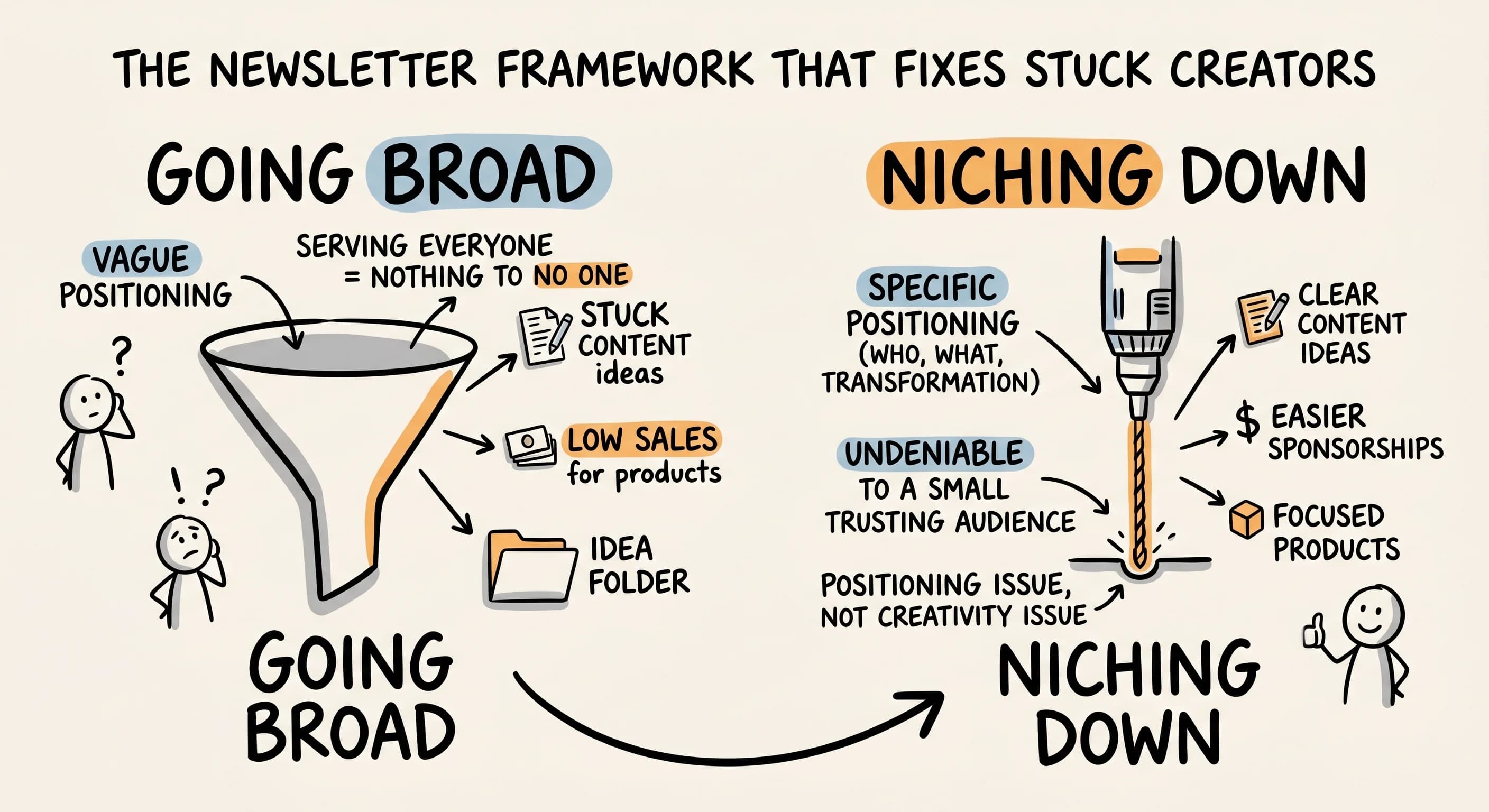
You've missed three publishing deadlines. Your content ideas folder is empty. You've launched two products that barely sold. Most creators blame discipline or inspiration when this happens. But the real culprit is almost always a broad, undefined positioning statement.
This single realization can change your entire content strategy, monetization direction, and publishing consistency faster than any productivity hack. Whether you're a solo founder, a marketer, or a seasoned operator trying to diversify income streams, the fix is the same: get specific about your newsletter niche.
Creators, Should You Niche Down or Stay Broad?
Your newsletter niche is the single decision that shapes everything else: how you create content, how you attract subscribers, how you land deals, and how you eventually scale. We will also look at what happens when you niche down, why a small audience can outperform a massive audience, and how to build a brand wide enough to expand later without confusing the readers you already have.
The stakes are simple. A sharp newsletter niche gives every issue a clear reason to exist in someone's inbox. A vague one leaves your best content ignored next to everything else competing for attention there.
The Root Cause Behind Every Content Block
 Think about it. If your newsletter serves anyone interested in email marketing, who exactly are you writing for today? What pain point are you solving? What product makes sense to pitch?
Nobody knows, including you.
Clear newsletter positioning defines three non-negotiables:
- Who your audience is (specific, not vague)
- What problem you solve for them
- What transformation you deliver
When those three pillars are solid, content ideas and income opportunities become obvious rather than overwhelming. This is backed up by positioning expert April Dunford, author of Obviously Awesome, who argues that when teams are stuck on messaging or product direction, it is almost always a positioning issue, not a creativity issue.
The same logic applies directly to your newsletter.
What Happens When You Niche Down?
Niching down is not about making yourself smaller. It is about making yourself undeniable to a specific niche of readers who feel like you are writing only for them. A small audience that trusts you completely is more valuable than a massive audience that barely remembers your name.
Consider Instagram. The platform succeeded in large part because it stayed hyper-focused on visual sharing rather than trying to absorb every social feature at once. Do you believe it would have been as successful if Facebook had merged all that functionality into the main app and tried to build a super-app from day one? The pattern is consistent: focused products win. Hyper-niche positioning builds loyalty faster than trying to serve everyone.
The same principle applies when you create content. A newsletter that goes deep on one specific niche earns more engagement, higher open rates, and stronger word-of-mouth than one that tries to cover every angle of a broader topic.
How I Land My First Sponsor (And What Came Next)
When a newsletter has a clearly defined, high-value readership, sponsorship conversations become straightforward. You are not selling reach. You are selling access to a specific niche of decision-makers who are already engaged.
The strategic path usually follows a rhythm: build the content foundation first, let engagement grow organically, then approach brands with documented audience data. Notice the lack of sponsors in many early newsletters? That is almost always a positioning problem, not an audience size problem. Once you can tell a brand exactly who reads your content, why they read it, and what actions they take, the conversation shifts entirely.
Next, many creators want to push even further and ask: what if brands actually paid me to feature them? That is where a tightly positioned newsletter becomes a genuine asset. Brands want placement in front of a specific niche, not a vague general audience. When your positioning is clear, you can monetize that specificity directly.
What Does Niche Down X Brand Wide Mean?
Newsletter strategist Matt McGarry, who has grown over 100 newsletters and driven more than 10 million subscribers, puts it plainly: most newsletters fail because they try to be everything to everyone and end up being nothing to no one. His recommended approach is to pick a niche and go two levels deeper. For example, business becomes marketing, which becomes social media marketing. Each layer sharpens your content, your audience, and your path to making money from what you publish.
Mike Romaine of Newsletter Engines calls this "niching down but branding wide." Tighten your content and value proposition now, but build your brand identity with enough breadth to evolve later.
If you niche into paid subscription newsletters, frame your brand around newsletter business strategy so you can later expand into other models without confusing your audience. You start narrow and expand as you grow, rather than starting with a broader scope and trying to narrow down after the fact, which tends to alienate the readers you have already built.
The Niche-Down Framework in Action
 That pattern plays out in practice. Start with a category like newsletter creators, niche down to newsletter businesses, then go further to paid subscription newsletters. Each step sharpens the content calendar, clarifies the audience's pain points, and identifies exactly which products to build.
This is the framework in practice:
Step 1: Audit Your Current Niche and Positioning
Rewrite your newsletter's core statement: who it's for, what problem it solves, what transformation it delivers. Be ruthlessly specific. If it still sounds like it could apply to ten different newsletters, it needs more focus.
Step 2: Go Hyper-Niche Until It Feels Almost Too Specific
If email marketing founders still feels vague, go deeper. Are they bootstrapped startups? Solopreneurs scaling past 5,000 subscribers? B2B operators exploring e-commerce integrations? Product managers at growth-stage companies? The more specific you get, the easier everything downstream becomes. This is how you build a specific niche that actually converts.
Step 3: Map Your Audience's Pain Points
List ten specific problems your niche faces right now. These become your content calendar. Each pain point is an article, a deep dive, a LinkedIn post, or an email sequence. You stop brainstorming topics and start solving documented problems. A simple template works well here: problem, context, solution, next step.
Step 4: Turn Pain Points Into Products
The same list that fills your editorial calendar tells you exactly what to build, whether that is a course, a coaching program, a virtual workshop, a platform tool, or an actionable resource hub. The content and the product come from the same source. This is how you build a portfolio of offers that all make sense together.
How to Niche Down a Tech or Startup Newsletter
This question comes up often. Need advice on growing your startup? Need help scaling your product or business? A tech newsletter that tries to cover everything globally ends up serving no one well.
The strategic move is to pick one intersection: perhaps early-stage founders who need to run ads on a limited budget, or product managers navigating a pivot from B2C to B2B. These are real, documented problems. A newsletter that addresses them directly will attract a loyal following far faster than one promising to cover all of tech.
You know how you wish you had stuck with YouTube back when you were younger, because the people who kept going have completely different lives now? The same logic applies here. The creators who picked a specific lane in their first year and stayed consistent are the ones who scaled to 7 figures while others are still figuring out their positioning.
Why not mix your personal journey with the topic? Unique life experiences relative to most people in your space are a positioning advantage. What do you believe differently than many others in your niche? That perspective becomes the editorial voice that makes your newsletter irreplaceable. A hybrid approach combining personal narrative with expert analysis tends to outperform either format alone.
Real Creator Results From Going Narrow
This is not theoretical. Ankit Aswal grew a niche newsletter into a $5,000 per month side hustle by tightening his audience focus and layering monetization strategies including affiliate deals, premium content tiers, and sponsored placements. The income consistency came from knowing exactly who he was serving and what they needed next.
Successful paid newsletters like Trends.co, Growth Marketing Examined, and The Profile all follow the same pattern. Each is positioned tightly around a clear reader outcome: better business ideas, better growth tactics, better mental models. Their paid monetization works precisely because their positioning is narrow enough that subscribers know what transformation they are getting.
The Growth Currency blog captures why so many creators stay stuck: they do not start or do not grow because they cannot decide on a niche. But once creators pick a hyper-niche and commit to learning everything about it, content consistency and audience growth tend to follow. Heavy constraints, it turns out, are often helpful.
Which Newsletter Niches Are Most Profitable?
Not every newsletter niche monetizes equally, and the reason is buying power. The most profitable newsletter niches tend to serve readers who control a budget: B2B operators, finance and business owners, product managers, and other decision-makers. Advertisers pay a premium to reach them, which is why B2B newsletters are often more lucrative per subscriber than a much larger general-interest list.
That does not mean you should chase a niche purely for money. It means you should weigh two things together: how tightly you can position your newsletter, and how much your readers' attention is worth to a sponsor. A super-niche audience with real purchasing power is the combination that turns a small list into a business.
Whichever niche you pick, the platform you build on matters less than the positioning. Tools like beehiiv make it easy to launch and monetize a niche newsletter, but the software does not choose your niche for you. That decision is yours, and it is the one that determines whether sponsorships and paid tiers ever become an option.
Platform-Specific Application for Newsletter Creators
For newsletter operators, positioning clarity drives every growth lever. Subscribe rates improve when your value proposition resonates with a specific reader. When you can tell a brand exactly who reads your content and why they are valuable, you can monetize that relationship directly.
You should also think about where else your audience lives. Instagram is worth considering for visual content and community building around your newsletter brand. Substack is an email platform that rewards narrow, opinionated writing, making it a natural fit for hyper-niche newsletters that want to build a direct relationship with readers without relying on algorithmic distribution.
Your LinkedIn content sharpens too, because you know exactly which insight will land with your specific reader rather than writing for a vague general audience. Is your topic trending on LinkedIn right now? That is a signal to hit publish sooner rather than later.
Lenny Rachitsky, whose newsletter reaches hundreds of thousands of product and startup professionals, frames positioning as the foundation that everything else is built on. Messaging, growth tactics, and monetization are all downstream of positioning clarity. Get that right first, and the rest follows.
Is There Room to Expand Later?
Yes, and this is where branding wide pays off. Once you have built authority in a specific niche and your audience trusts you, you can expand into adjacent topics without losing credibility. The key is that you expand from a position of strength rather than confusion.
A newsletter that starts with paid subscription strategy can expand into broader newsletter business operations because the brand has earned that authority. A fitness newsletter built around endurance athletes can expand into nutrition, recovery, and training tools because the audience already trusts the editorial voice. The breadth of expansion is earned, not assumed.
Your Next Step
Whenever you feel stuck on content or income, treat it as a positioning signal. Revisit your statement, niche down further, map the pain points, and let that clarity do the work.
Positioning is not a one-time exercise. Schedule a quarterly review. Ask whether your current statement still reflects who you are serving and what transformation you are delivering. Only after that, run your content ideation and make sure every idea directly addresses a mapped pain point for your specific reader.
Start narrow. Build the whole solution for a well-defined group. Then expand from a position of strength.
Read more about Becoming a Content Creator
📚 Complete Guides
- How to Become a Content Creator: Complete Beginner's Guide
- Content Creator Platform Guide: Choose the Right Platform to Start Your Creator Journey
⚡ Tactics & Strategies
- 50% Retention Rate Optimization for YouTube Algorithm Success
- Age Bracket as Superpower Strategy for Older UGC Creators
- AI Workflow Integration for Content Reduction
- Audience Consistency Strategy to Avoid Algorithm Penalties
- Audience Poll on Instagram to Source Q&A Content in Advance of Recording
📄 Related Articles
- Brand Deals on Instagram: How to Get Them Under 10K Followers
- Podcast Monetization Strategies: Earn From Episode One
- How to Negotiate Brand Deals as a Content Creator Using Your Membership Audience
- Free Content vs Paid Content: Are You Giving Away Too Much?
- Content Decay: How to Find and Fix Pages Losing Rankings
- Membership Community: Test It Before You Charge
- The Four Sentence Story: A Writing Exercise for Better Content
- Competitive Content Analysis: The 5-Competitor Method
Read more about Monetization & Business Models for Content Creators
📚 Complete Guides
- Content Creator Monetization: Proven Revenue Streams
- Content Creator Income Streams: 7 Ways to Build Financial Stability
⚡ Tactics & Strategies
- 30 Daily Outbound Pitches for UGC Deal Generation
- Affiliate Code Negotiation Using Membership Audience Influence
- Age Bracket as Superpower Strategy for Older UGC Creators
- B2B Merchandise Bulk Sales to Industry Professionals- Packaging Products as Client Gifts for Lawyers and Service Providers
- Becoming Your Own Sponsor by Plugging Your Offer Within Episodes
🧮 Calculators
Read more about Systems, Workflows & Operations for Content Creators

Alex Kirillov
Details
One link. Every channel, rate, and piece of work brands need to evaluate you. Built for how creators actually get hired.
Claim your profile
Live creator, content, and marketing roles from real companies, with the pay, market, and context the raw job page never gives you.
Browse jobs