
The Future of Online Courses: What AI Means for Course Creators
AI is commoditizing self-paced courses fast. Here's what course creators need to do right now to protect their business and build products AI can't replace.
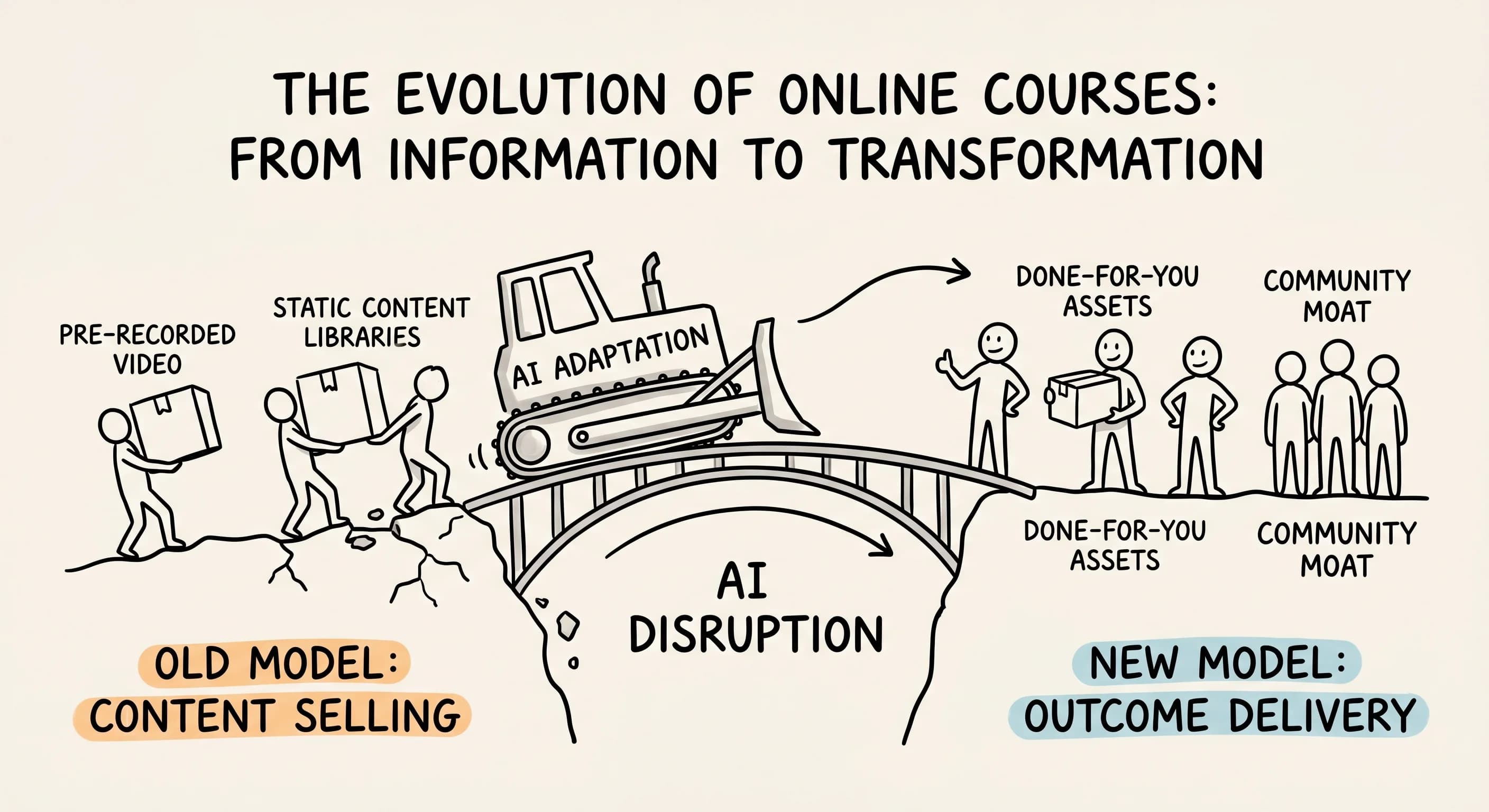
The online course gold rush is over. AI isn't just knocking at the door of your course business, it's already inside, rearranging the furniture. And if you're still selling self-paced, content-heavy courses, you need to hear this clearly: the product model that built the online education industry is being quietly dismantled.
This isn't doom-and-gloom. It's a real opportunity, but only if you move in the right direction.
The Evolution of Online Education and the AI Turning Point
Before we talk about your course business, it's worth zooming out. The evolution of online education has moved fast: distance learning started as a convenience, digital learning grew into a credible alternative to campus study, and now AI is compressing that timeline even further. Higher education institutions, online platforms, and independent course creators are all feeling the pressure simultaneously.
At the current pace of change, it's worth asking whether students today are among the last to work with an all-human faculty. The question "can AI replace college?" is no longer hypothetical. Artificial intelligence is reshaping how institutions deliver instruction, assess performance, and support students, and the pace is accelerating faster than most educators anticipated.
AI-powered platforms are now capable of delivering personalized learning experiences that adapt in real time to each student's pace, gaps, and goals. Generative AI tools can produce lesson content, quizzes, and feedback loops on demand. AI tutors are available around the clock, removing the scheduling constraints that once made human teachers irreplaceable by default.
Could AI give someone a degree? Not yet in any accredited, meaningful sense. But the use of AI in education is already replacing significant portions of what a traditional degree program delivers. AI-driven content delivery, automated grading, and adaptive learning paths are all active today on platforms like Coursera. The question is no longer whether AI becomes part of education. It already has.
Still, fully replace the college experience? That's a harder case to make. The social development, credentialing systems, human interaction, and mentorship networks built inside universities are not simply information-delivery problems that AI can solve. AI would need to replicate human relationships, institutional trust, and real-world signaling to do that, and those are domains where technology still falls short.
Why AI Could Replace Your Online Course Business
 Information wants to be free, and now it finally is. ChatGPT and tools like it have become some of the most effective educators on the planet. An AI tutor is infinitely patient, completely judgment-free, deeply private, and meets each learner exactly where they are. No static pre-recorded course can replicate that online learning experience.
Stanford HAI describes AI language models as adaptive tutors capable of simulating confusion, asking follow-up questions, and giving personalized feedback, enabling online students to take risks without social judgment. That's not a feature your video library offers.
Meanwhile, AI platforms in higher education are already auto-generating structured lesson plans, assessments, slide decks, HTML modules, and video lessons from simple lecture notes and learning objectives. The course shell, the format that once took weeks to build, is now a commodity anyone can produce in an afternoon.
If your course primarily transfers information, that value proposition is eroding fast. The uncomfortable audit question you need to ask yourself: how much of your content could AI help deliver more effectively right now? Be honest. The answer is probably more than you'd like.
The Future of Online Education for Course Creators
 This shift doesn't mean online teaching is dead. It means the type of product you sell has to evolve, and fast. The future of online education belongs to creators who understand what learners are actually paying for.
The eLearning Industry puts it plainly: AI isn't killing the online course industry. It's killing the old version of it. People never actually paid for knowledge. They paid for transformation. That distinction matters more now than it ever has.
So where do course creators fit in the world of ever-advancing AI capability? The creators who will thrive are those pivoting from "let me teach you how" to "here's the done-for-you result." That pivot isn't a small tweak. It's a fundamental rethink of your product architecture.
AI may not replace the human elements of great instruction, but it will replace the parts that are purely informational. Teachers must adapt by focusing on what technology cannot automate: judgment, mentorship, accountability, and the kind of teaching and learning that requires genuine human presence.
Is AI Really Replacing Teachers in Virtual Education?
The honest answer is: partially, and selectively. AI does not replace humans wholesale, but it is replacing specific tasks. Automated grading is already widely deployed. AI-powered feedback tools review drafts, flag errors, and suggest revisions without human input. Administrative tasks like scheduling, progress tracking, and content recommendations are increasingly handled by AI systems rather than instructors.
Human teachers still matter, and they matter most in roles that require trust, nuanced feedback, emotional intelligence, and the ability to help students navigate ambiguity. Instead of replacing human teachers entirely, AI is compressing what teachers must do manually, freeing them to focus on higher-order work.
This is how AI is reshaping learning environments: not by removing people, but by shifting where their time and attention go.
Plug-and-Play Resources Win Where AI Struggles
AI excels at explaining concepts. What it doesn't do is save your customer the time of actually building something. That's your competitive edge right now.
Templates, swipe files, systems, and done-for-you assets deliver outcomes directly, without forcing buyers to develop new skills first before they can apply them. These products have pure utility. And utility is AI-resistant.
Think about what your audience actually wants, not the skill, but the outcome. A social media caption library, a business plan template, a complete launch checklist, a prebuilt Notion system. These products do the work. Discovery Education's research on AI in education reinforces this exact logic: the most durable value comes from tools that remove time-consuming work so people can focus on what only they can do.
Course creators in the creator economy are already making this move, pivoting from video modules to SOP bundles, prompt libraries, email swipe files, and prebuilt automation systems as their primary products. The recorded content becomes optional support material, not the core offer.
Ask yourself: can you build a tool that delivers your audience's desired outcome instead of teaching them to achieve it themselves? That's where your energy belongs.
Technological Advancements Shaping the Future of Online Courses
The key trends shaping online learning right now go well beyond AI chat tools. Technological advancements in immersive media are opening up entirely new learning spaces. Virtual reality (VR) and augmented reality are moving from novelty to practical tools: VR lets online learners practice skills inside simulated environments, while augmented reality overlays real-world context onto what they're studying. Together, VR and AR are starting to revolutionize training in fields like healthcare, engineering, and skilled trades, delivering immersive, hands-on experiences that a flat video screen simply can't match.
Mobile learning is another force shaping trends in online education. A growing share of online programs are now designed for phones first, giving a diverse student population the flexibility and convenience to learn during commutes, breaks, or any spare window in the day. Collaborative learning tools, live cohort formats, and real-time peer feedback are all easier to access from a pocket-sized device than they were even three years ago.
These trends and innovations matter to course creators because they raise the bar for what online programs need to deliver. A fully online course that's just a folder of videos feels thin compared to what an immersive, well-designed learning experience can offer today. If you're drawing on these advancements, you're building something that can actually compete.
Integrating AI Into Your Teaching Methodology
For creators who want to preserve an educational offer, the answer isn't to fight AI. It's to build it directly into your instruction. AI can help you create a more flexible and effective learning experience than a static video course ever could.
McGraw-Hill's Learning Coach is a useful proof of concept here. It's a conversational AI tutor embedded inside their course platform, providing in-the-moment support as students work through challenging material. That's a static course becoming a dynamic, interactive experience. You can do a version of this too.
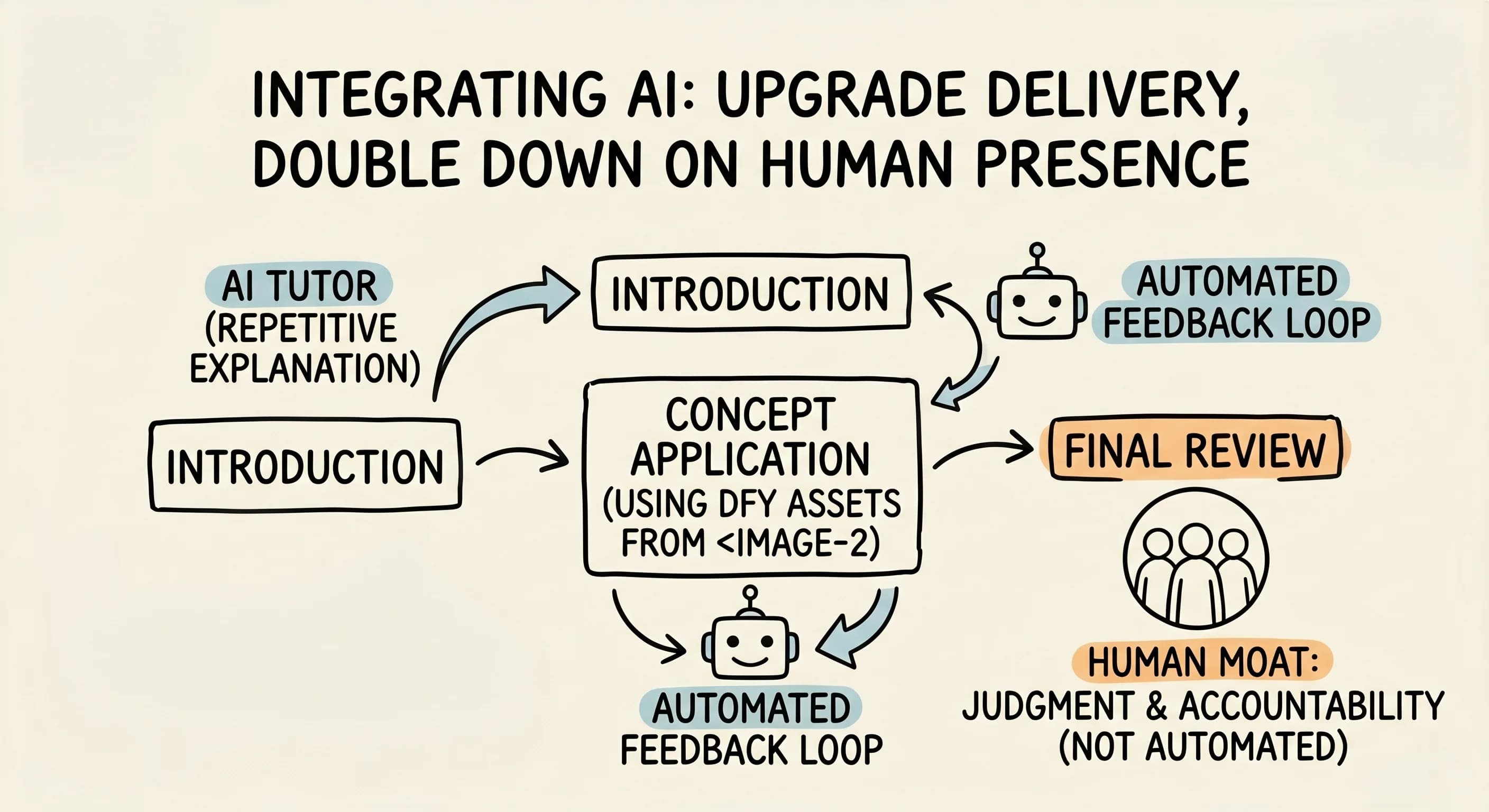
Build custom AI tools. Create guided prompt sequences. Design interactive exercises that give learners immediate feedback. This transforms passive consumption into active practice, and that's the kind of experience that can actually compete alongside AI tools rather than against them.
Personalization is now a baseline expectation. Personalized learning, where content adapts to individual needs and learning outcomes are tracked in real time, is something AI-powered systems can deliver at scale. This matters especially when you're serving online learners with different learning styles, backgrounds, and goals. LLMs like ChatGPT can already help generate personalized content on the fly, making it feasible to create custom learning paths without rebuilding your course from scratch.
The principle is straightforward: let AI handle the explanation and repetitive instruction. You focus on building the assets, the frameworks, and the human layer that AI can't replicate.
Advantages of Online Education and the Accessibility Question
One of the clearest advantages of online education is access to education for people who couldn't otherwise get it. Online programs have always had the ability to bridge the gap between learners who live far from campuses, work full-time, or can't afford to relocate. Accessibility, in terms of both physical access and financial reach, is one of the most compelling reasons the online learning market keeps growing even as AI disrupts the content side of it.
Do you feel drawn to e-learning as a vehicle for continuous professional development? You're not alone. Online learners increasingly come to digital learning not just for degree programs but for professional development, skill updates, and lifelong learning that fits around a career and a life. That demand doesn't disappear because AI can explain concepts. If anything, it grows, because the job market keeps shifting and people need to keep up.
Higher education institutions are recognizing this too. The role in shaping access and inclusion that online learning plays is significant: it opens learning opportunities to a diverse student population that traditional campuses were never built to serve at scale. Course creators sit inside that same story. The educational resources you build, the community you host, and the human guidance you provide are part of what makes the future of online courses matter beyond just the business case.
Global Trends in Online Learning and What Comes Next
So, what can we expect from online education in the next five years? The global trends in online education point in a consistent direction: more personalization, more immersive technology, more collaborative learning structures, and a clearer separation between courses that just deliver information and online programs that deliver real outcomes.
Will online learning replace brick-and-mortar institutions? Almost certainly not wholesale. But the line between campus and online keeps blurring. Hybrid models, AI-powered support tools, and mobile learning options mean that higher education institutions that once saw online as a secondary channel are now treating it as central. That's the environment course creators are competing inside, and it rewards people who are shaping the future of online with intentional, human-led design rather than just publishing more content.
The future trends are clear enough to act on now: utility beats information, human connection beats passive content, and immersive or interactive learning beats a folder of videos. These are the forces that will shape the future of learning opportunities for online students and course creators alike.
Community as a Defensible Moat
Human connection is the one thing AI genuinely cannot fake at scale. And the research backs this up consistently.
Stanford HAI stresses that great teachers and genuine human relationships remain the cornerstone of effective learning. The U.S. Department of Education's AI report similarly confirms that motivation, accountability, and real relationships stay central to how people actually learn and follow through. Discovery Education frames it directly: AI supports teachers, it doesn't replace teachers.
What AI cannot provide is verified, accountable human presence. It can't give you status, belonging, peer accountability, or the feeling that someone genuinely invested in your success is watching. Mentorship, live cohort experiences, peer critique, and mastermind-style calls deliver all of that. These are the human elements that define a truly valuable college experience or premium online program.
Too much flexibility can actually be overwhelming. Where do you start, and how do you know what to focus on? That's where human guidance creates irreplaceable learning and growth. If you're building community-based offerings, double down on the quality of those human relationships as your core differentiator.
How AI Prepares Students for the Future of Work and the Job Market
The future of education isn't just about delivering content more efficiently. It's about preparing students for a world where AI is a daily work tool. Helping people stay relevant in a shifting job market is one of the most valuable things an online course creator can do right now, and that means teaching students to work together with AI systems, not compete against them.
This is how the use of AI in education supports learning outcomes beyond the classroom. Students who experience AI-integrated instruction develop fluency with tools they'll encounter in virtually every knowledge-work environment. That's a better preparation for careers and for lifelong learning than any static content library.
Course creators who are already integrating AI into their programs, building collaborative learning structures, and focusing on outcomes over information are the ones shaping the future of online courses. That's where the real advancement in online education is happening, and it's happening now.
Your Action Plan for the AI Era
 Audit every course you sell. Identify any module whose primary function is explanation or generic exercises. Those are the most vulnerable to AI right now. Then ask what your customer really wants: not the skill, but the specific outcome.
Here's a practical framework to work through:
Step one: Score each module honestly for AI-replaceability. Anything that's mostly explanation or walkthrough is a candidate to cut or hand off to an embedded AI tool.
Step two: Define your audience's desired outcome in operational terms. Not "understand content marketing", but "have a 30-day content calendar done and scheduled."
Step three: Ask what asset would deliver that outcome directly. Build it. A prebuilt system, a template, a fill-in-the-blanks document, a done-for-you resource your customer only lightly customizes.
Step four: Integrate AI to help customize those assets at scale. Let learners plug in their context and have the system adapt to their use case.
Step five: For higher-stakes outcomes, wrap everything with a live human layer, including calls, peer review, and accountability structures. That's where the real premium sits.
Course creators who survive this shift won't fight AI. They'll use AI to improve delivery while building product lines rooted in time-saving utility and irreplaceable human experience. The creators who act on this now will define what online learning looks like next.
Read more about Monetization & Business Models for Content Creators
📚 Complete Guides
- Content Creator Monetization: Proven Revenue Streams
- Content Creator Income Streams: 7 Ways to Build Financial Stability
⚡ Tactics & Strategies
- 30 Daily Outbound Pitches for UGC Deal Generation
- Affiliate Code Negotiation Using Membership Audience Influence
- Age Bracket as Superpower Strategy for Older UGC Creators
- B2B Merchandise Bulk Sales to Industry Professionals- Packaging Products as Client Gifts for Lawyers and Service Providers
- Becoming Your Own Sponsor by Plugging Your Offer Within Episodes
📄 Related Articles
- How to Price Creative Services: The Four-Pillar Framework for Freelancers and Designers
- Swipe File: How to Build One With Gmail Labels
- How to Build an Organic Marketing Strategy That Compounds Over Time
- How to Monetize Content Creation: Master One Stream at a Time
- Influencer Contract Template: What to Include (and Why)
- Email Segmentation: The Base Sending Strategy That Works
- Online Course Feedback: Use It to Improve Your Course
- Email List Growth Strategies: Turn Instagram Frustration Into Subscribers
🧮 Calculators

Alex Kirillov
One link. Every channel, rate, and piece of work brands need to evaluate you. Built for how creators actually get hired.
Claim your profile
Live creator, content, and marketing roles from real companies, with the pay, market, and context the raw job page never gives you.
Browse jobs